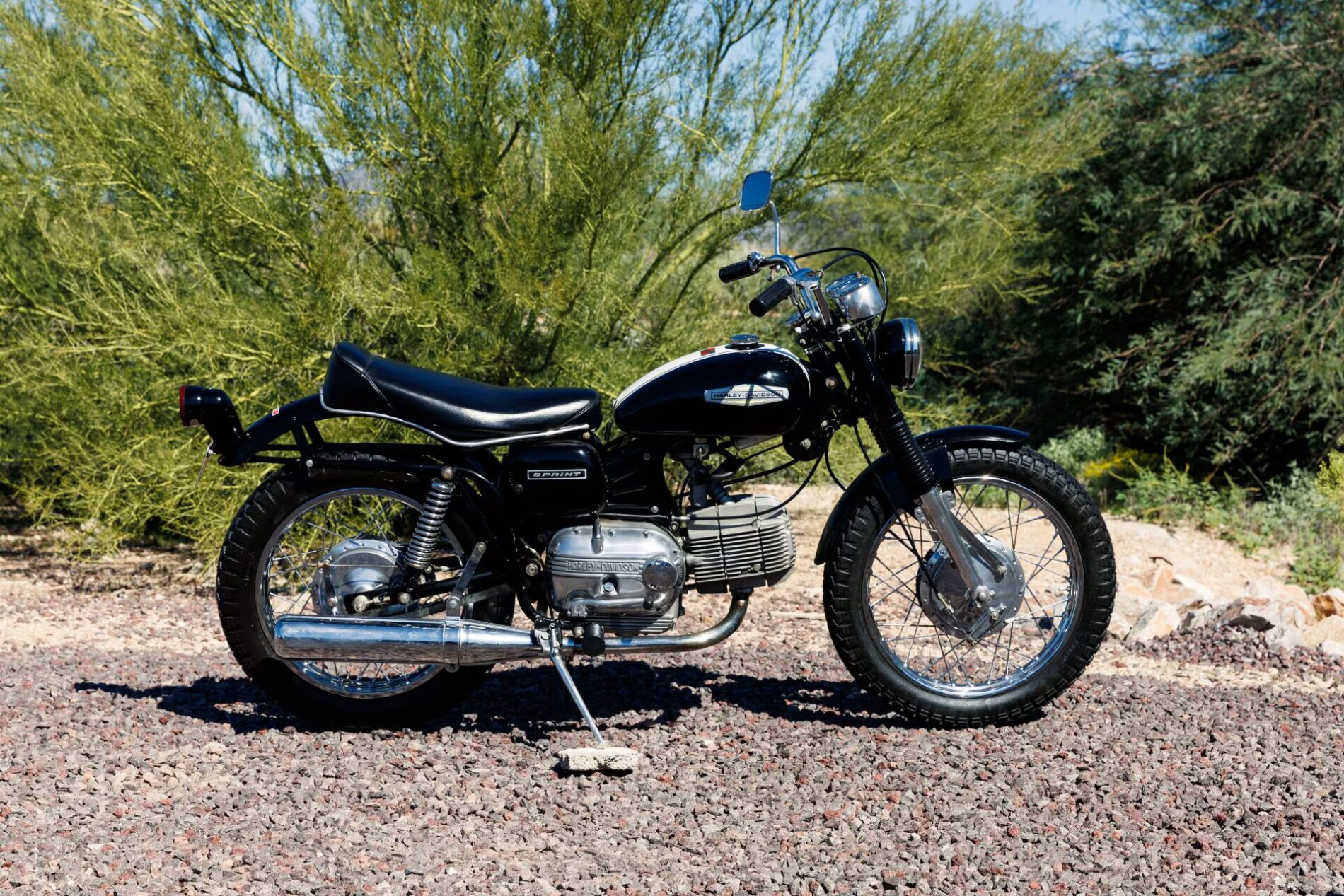
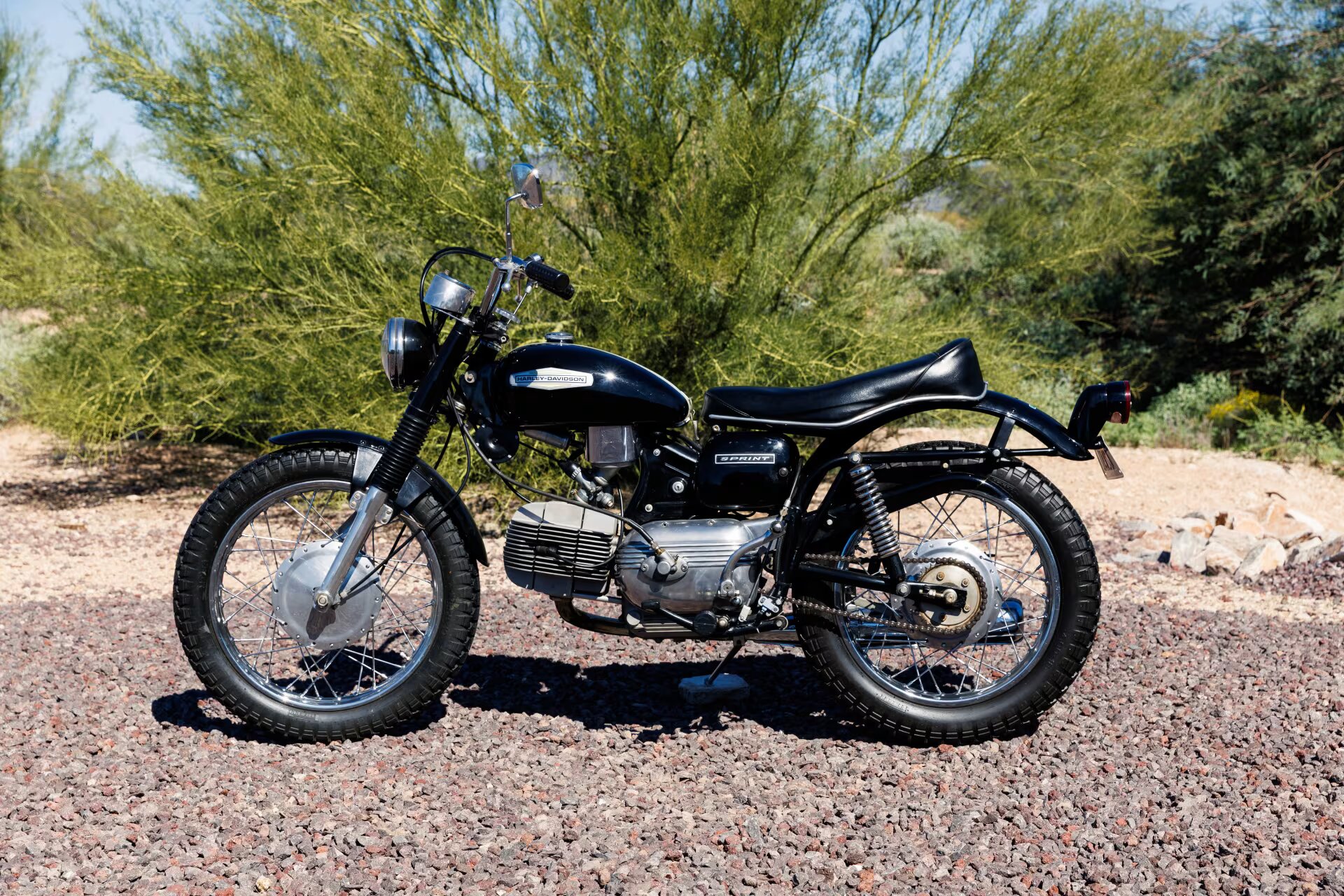
Harley-Davidson felt that they needed to field a smaller motorcycle than their big V-twin traditional bikes. To this end they obtained 50% share in Italian motorcycle maker Aermacchi and brought the Harley-Davidson “Sprint” range of motorcycles onto the US market.
Fast Facts
- The Harley-Davidson Sprint motorcycles were made in Italy by Aermacchi after Harley-Davidson acquired a 50% share in the company.
- The Sprint 250 and 350 models were offered as lightweight fun bikes with the ability to be tuned up to become viable motorsport competitors.
- The Sprint models filled a smaller bike product gap for Harley-Davidson and enabled them to compete with the Japanese motorcycles that were increasingly encroaching on the US market.
In the post World War 2 period of the 1950’s and 1960’s both Harley-Davidson and Indian explored the idea of importing European made motorcycles which had been “badge engineered” to become Harley-Davisons or Indians.
American motorcycles, like American automobiles of the period, tended to be large, heavy, and not at all lively in their handling.
American motorcycles also tended to be gasoline thirsty, a product of their weight and engine capacity coming up against the basic laws of physics.
Indian did not succeed in this venture, but Harley-Davidson did, and it was a move that helped them navigate a tempestuous financial journey that has led to them surviving through to the present day.
Over in Italy that post war period saw the country in a period of financial austerity with strong markets for small engine capacity motorcycles and automobiles. This was the era that gave birth to the Fiat 500 “Bambina” for example (and the era that gave birth to the British Mini).
Italian aircraft maker Aermacchi found themselves banned from making aircraft in the wake of the war and so they turned their attention to making motorcycles as a means of keeping the company alive.
Aermacchi’s engineers were a clever group of people who understood what was needed and who could create motorcycles that were affordable, utilitarian, yet also exciting with performance that exceeded that which could be reasonably expected.
Harley-Davidson’s decision makers approached Aermacchi’s management with a view to acquiring a fifty percent share in the company, and with that to market select Aermacchi motorcycle models in the North American market wearing the Harley-Davidson badge and distributed and maintained by the Harley-Davidson dealer network.
The deal went through and Harley-Davidson decided that the Aermacchi 250cc single cylinder motorcycle would be the right candidate to grace the floors of Harley-Davidson dealerships alongside the American made big and traditional Harley-Davidson V-twins.
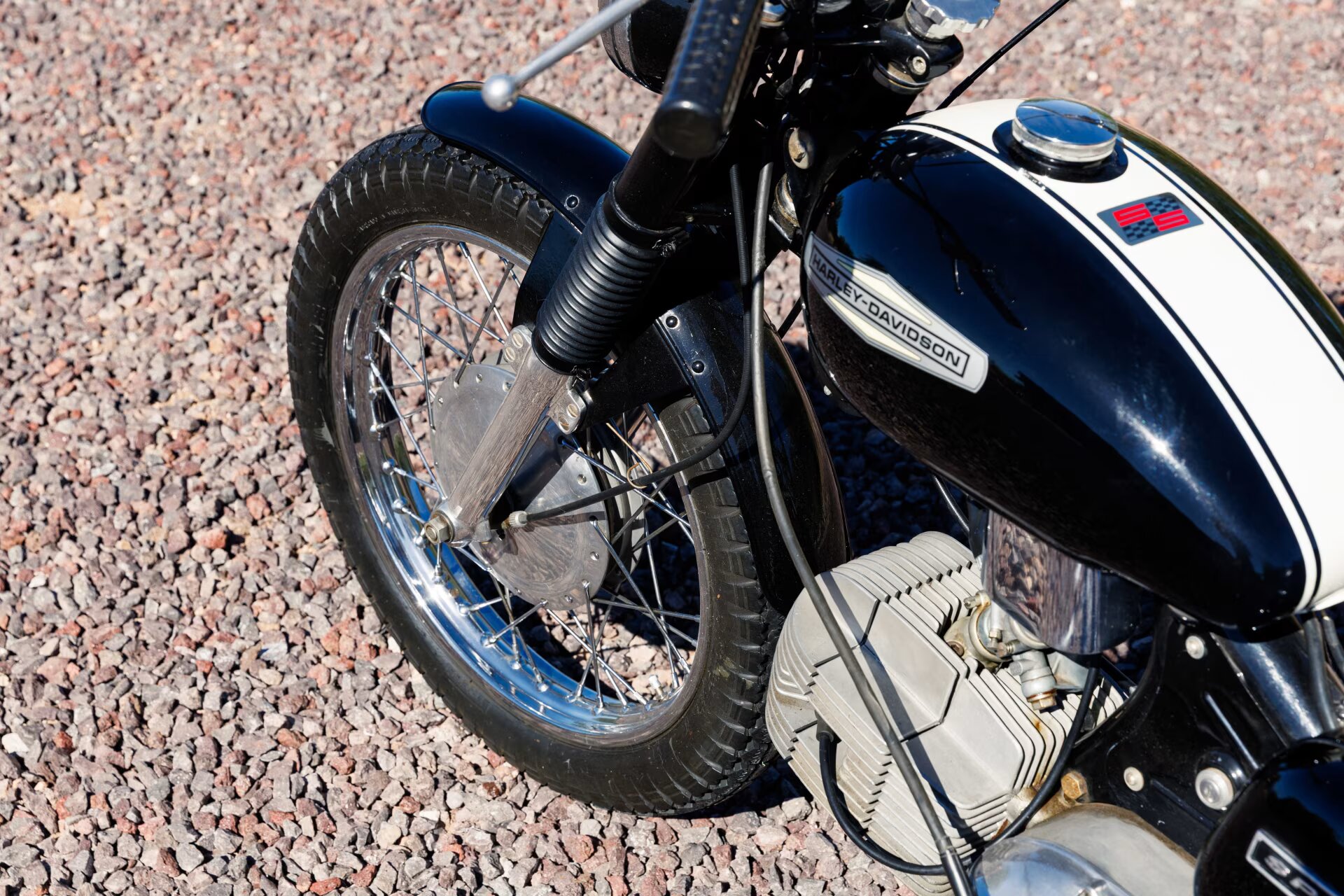
For some strange reason Harley-Davidson initially decided to call this 250cc model the “Wisconsin” but quickly dropped that to call the bike the “Sprint” – which would have rather better appeal to customers in all the other states of the US that were not Wisconsin.
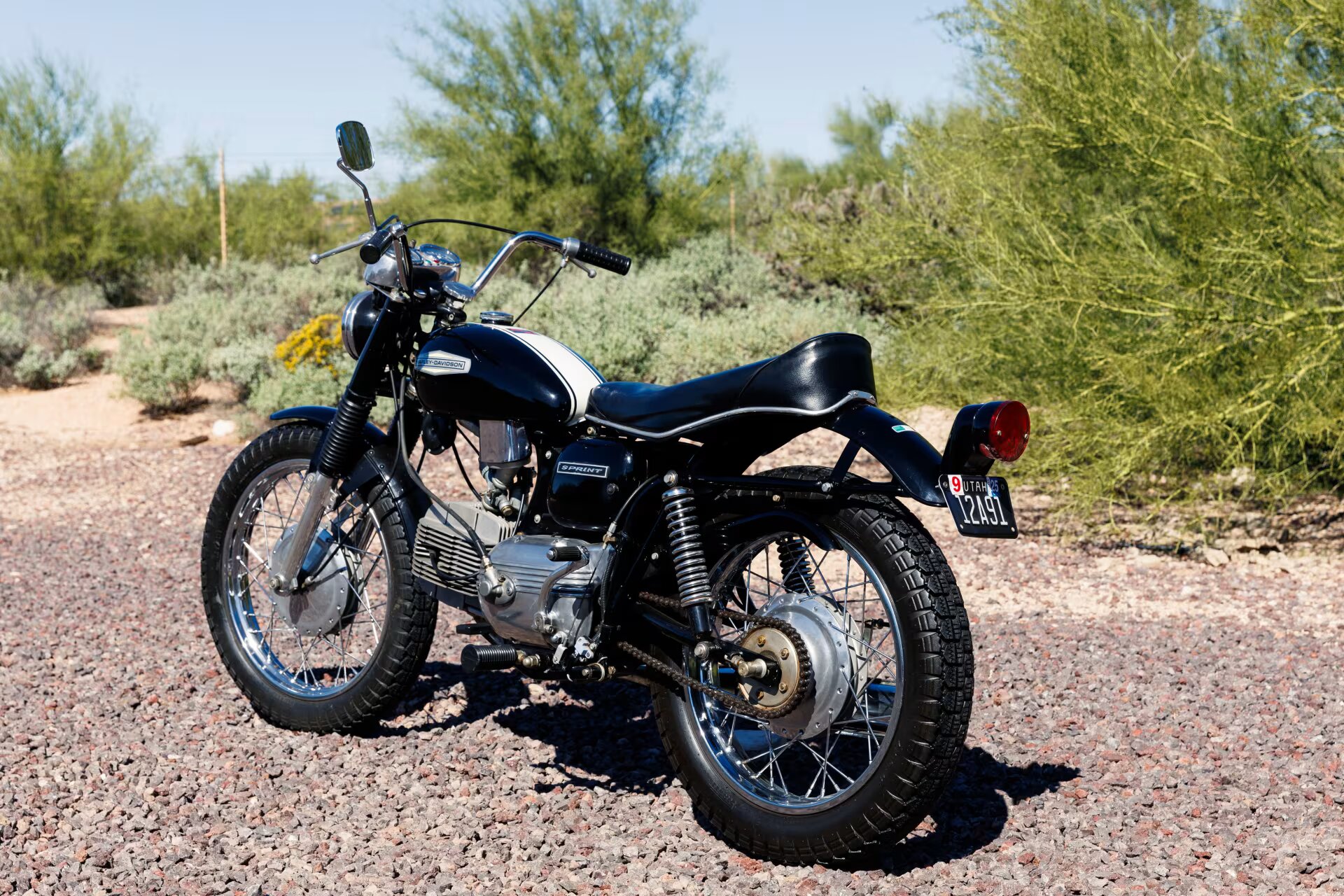
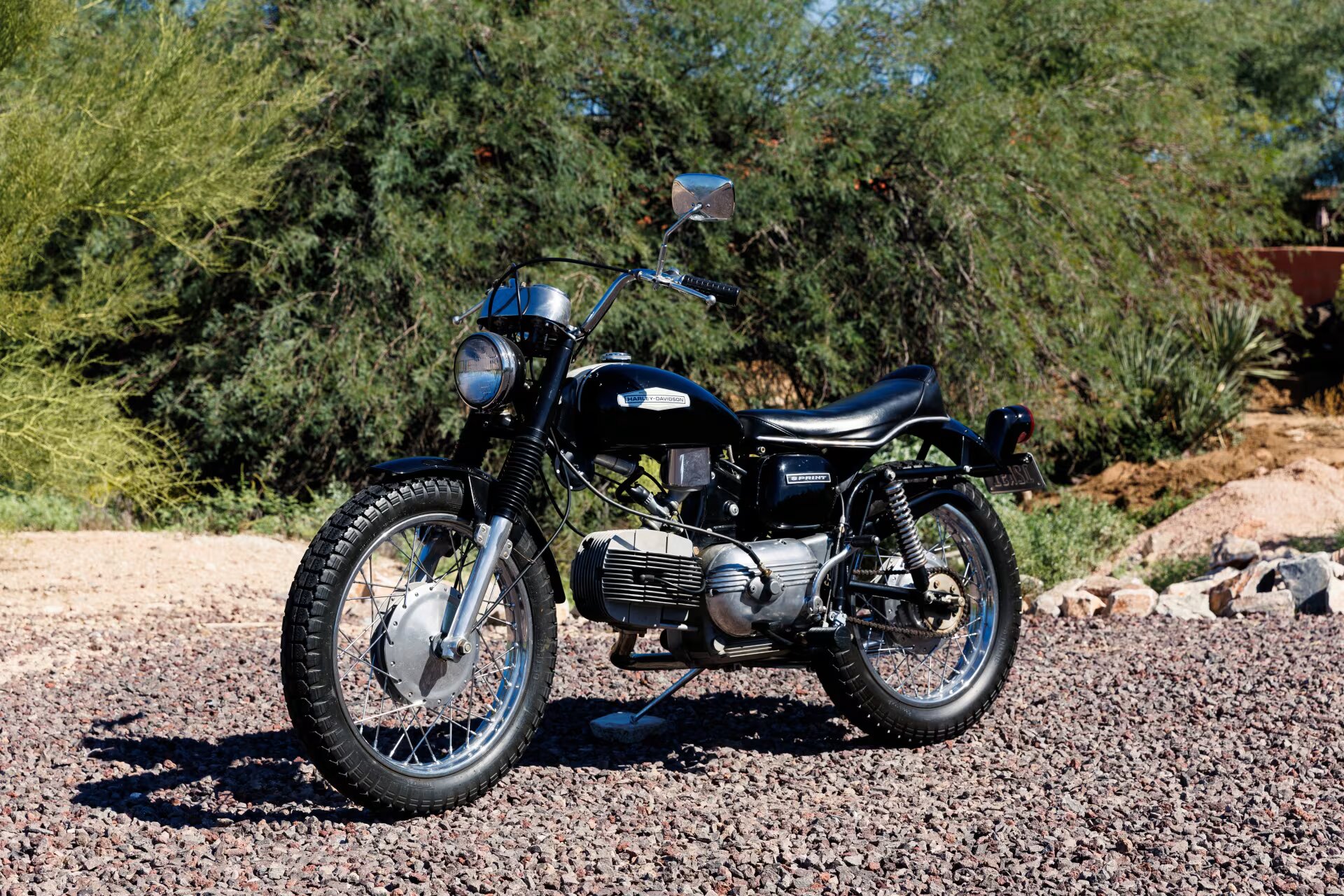
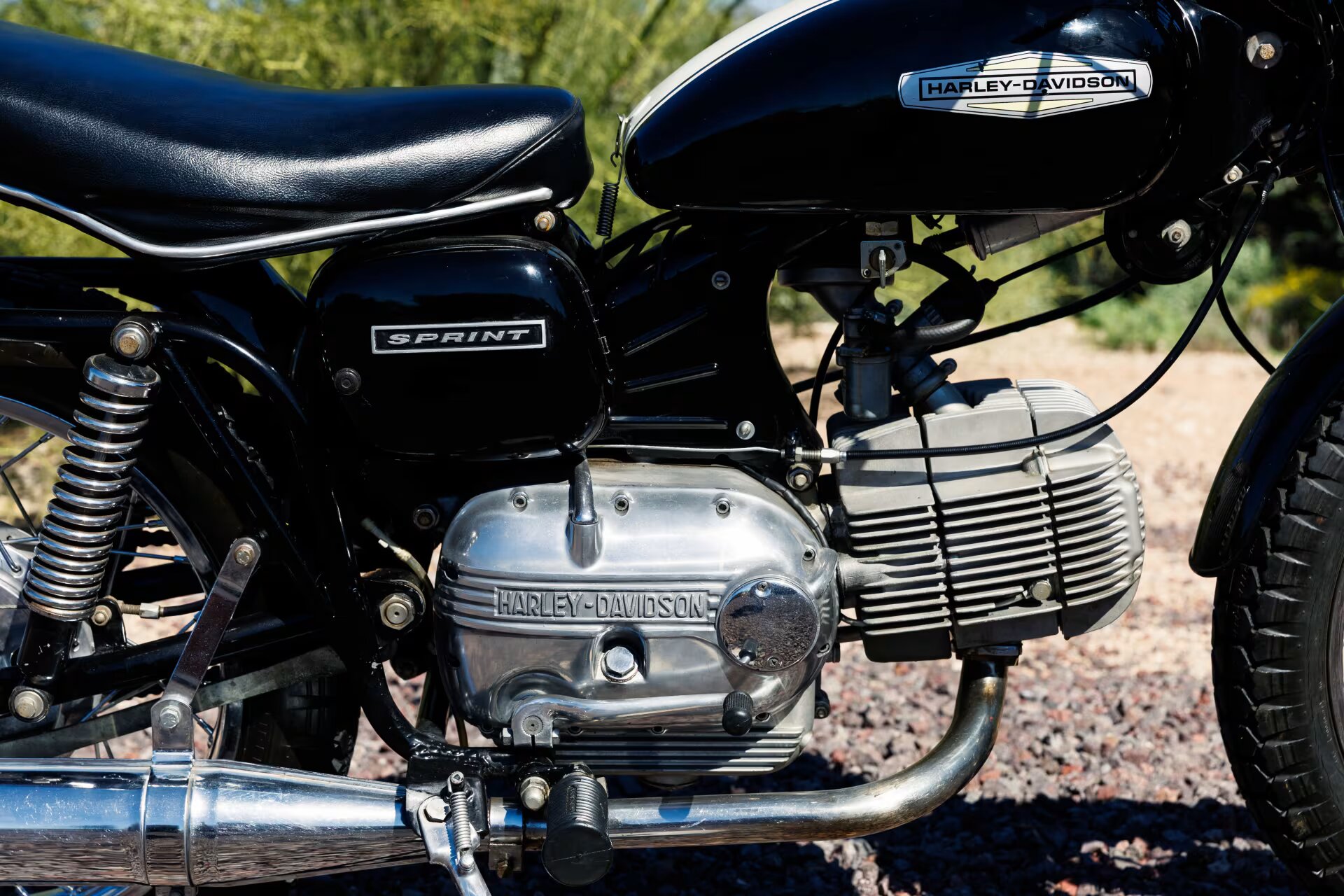
This bike was made to be not only reliable, but easy to maintain. The frame was based around a large diameter single tube that ran under the fuel tank and from which the single cylinder engine and transmission unit was suspended.
Front suspension was by telescoping forks and at the rear was a swing arm with twin shock absorbers.
Brakes were single leading shoe 7 inch drums front and rear. Wheels were 17×3 inch wire with some later versions moving to 18 inch. Tires were by Pirelli.
The air-cooled 246cc OHV single cylinder engine was aimed just above the horizontal at the front and directly in the air-flow. Compression ratio was 8.5:1 with some performance versions increasing that. Power was rated at 18hp @ 7,500rpm (13kW @ 7,500rpm).
The cylinder was of iron while the cylinder head alloy. Bore was 66mm and stroke 72mm. The crankshaft was supported at both ends by roller bearings. Lubrication was provided by pressure feeding from a wet sump, with oil capacity being 4 pints. The carburetor was a Dell’Orto.
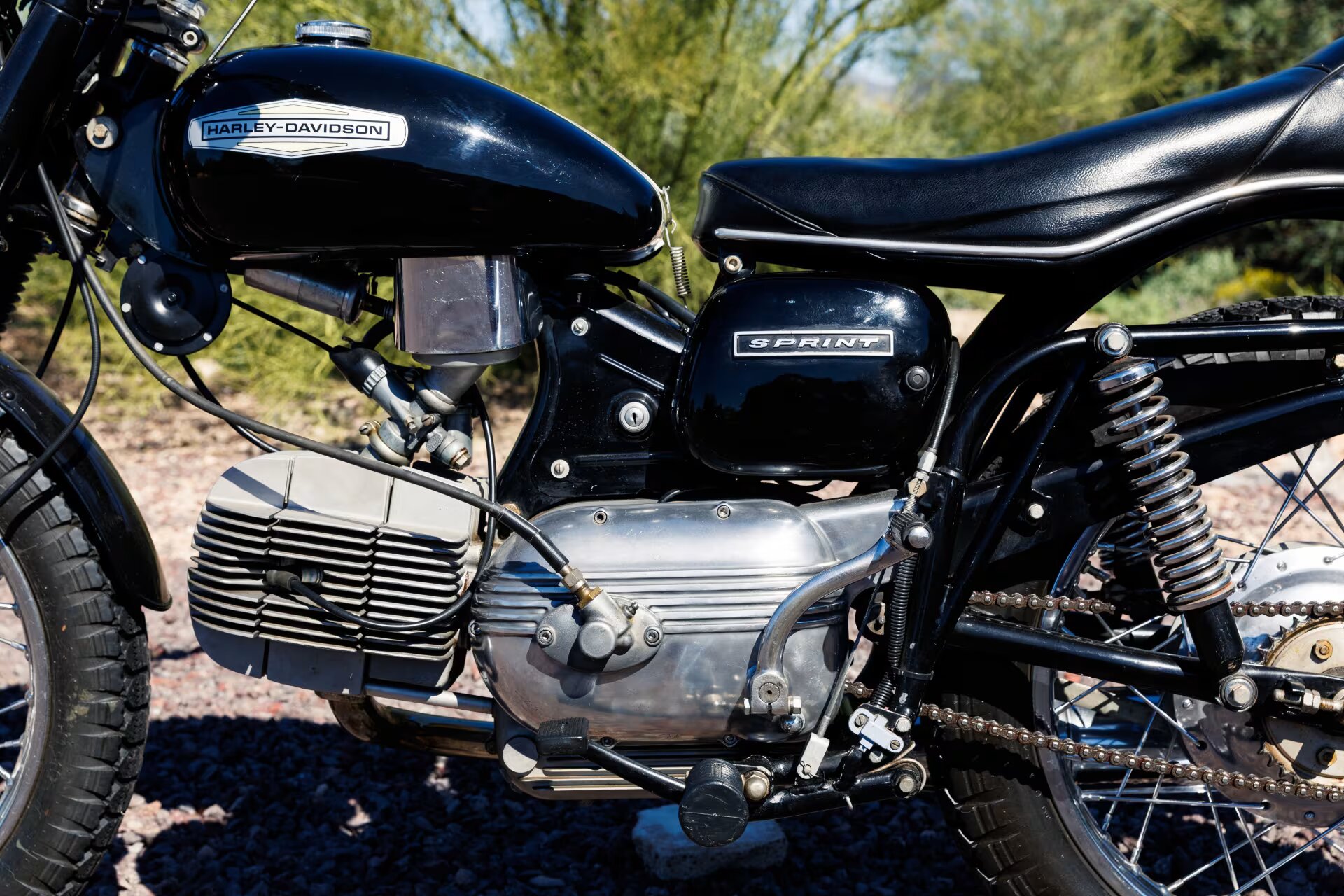
The clutch was a conventional multi-plate wet clutch and the gearbox 4 speed. Final drive was by chain.
The bike did not have an electric starter and instead depended on a left side mounted kick starter.
The electrical system incorporated a Bosch alternator, battery, and ignition coil.
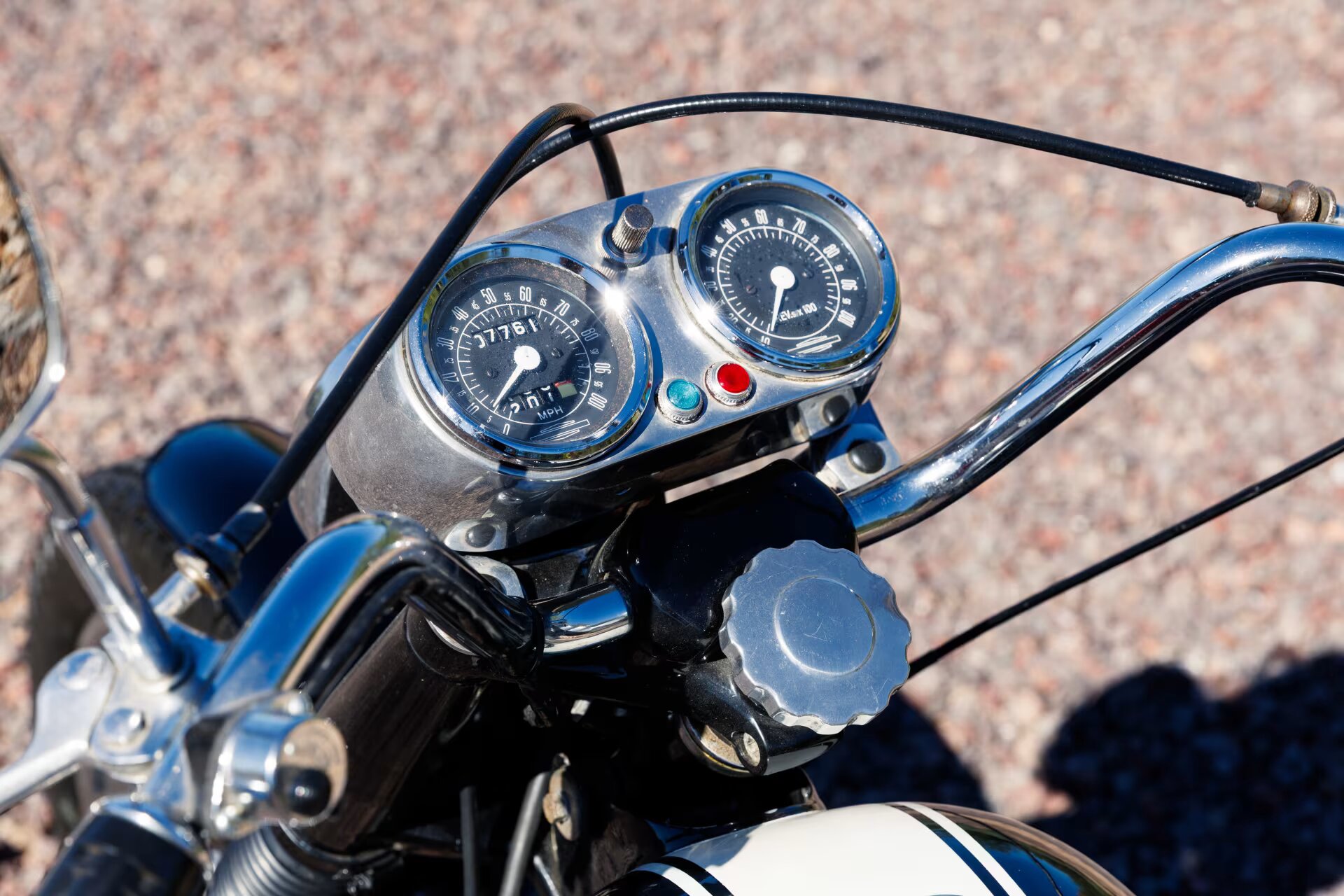
Standing to 60mph was achieved in around 15 seconds and top speed between 80-90mph.
Fuel tank capacity was 4 US gallons and the overall weight of the bike was about 270lb dry.
Overall this was a lightweight and lively handling motorcycle, easy to manage for a beginner rider, and able to be tweaked to make it a viable contender on race track or other motorsport competition. In short it was a great commuter bike, great fun bike, and a fabulous entry into motorcycling for new riders.
The only thing it wasn’t was that it wasn’t a traditional Harley-Davidson. But that being said it certainly provided competition to the Japanese motorcycles that were becoming popular in the United States at that time.
The Harley-Davidson Sprint went on to be modified for performance and a streamlined very tweaked up Sprint caused a bit of a stir in 1964 when it managed 150mph at Bonneville, and upped the anti the following year with a 177mph run.
The Harley-Davidson 250 Sprint served well and achieved a great deal for the company. But it could not prevent the financial collapse of Harley-Davidson and the need for it to be rescued by American Machine and Foundry (AMF).

Ultimately AMF/Harley-Davidson would go on to purchase a 100% share in Aermacchi, and in 1978 sold that to Cagiva who went on to create some outstanding motorcycles.
There is a 1967 Harley-Davidson SS 250 coming up for sale by Mecum Auctions at their 2026 Las Vegas Motorcycles sale.
To see the sale page for this bike click here.
There are also a few other Harley-Davidson Sprint motorcycles coming up for sale by Mecum Auctions at that Las Vegas Motorcycles sale. Click each of the links below to find the sale page and sale date for each one.
Picture Credits: All pictures courtesy Mecum Auctions.
Jon Branch is the founder and senior editor of Revivaler and has written a significant number of articles for various publications including official Buying Guides for eBay, classic car articles for Hagerty, magazine articles for both the Australian Shooters Journal and the Australian Shooter, and he’s a long time contributor to Silodrome.
Jon has done radio, television, magazine and newspaper interviews on various issues, and has traveled extensively, having lived in Britain, Australia, China and Hong Kong. His travels have taken him to Indonesia, Israel, Italy, Japan and a number of other countries. He has studied the Japanese sword arts and has a long history of involvement in the shooting sports, which has included authoring submissions to government on various firearms related issues and assisting in the design and establishment of shooting ranges.