Alvin Beisen was a man who endured the hardships of the 1930’s and went on to become one of the best American custom rifle stock, and rifle makers of the post Second World War years. He was a friend of gun writer Jack O’Connor and made a number of rifles for him.
Fast Facts
- Al Beisen was a custom stock and rifle builder of Spokane, Washington.
- Beisen is perhaps best known as one of the legendary Jack O’Connor’s rifle builders.
- The Al Beisen style of stock was a classic profile with slender grip and fleur-de-lis checkering, typically on carefully selected walnut or maple.
- Al Beisen’s rifle making business ultimately became a family affair with his son Roger and granddaughter Paula Biesen-Malicki joining his team.
- Two Al Beisen rifles are for sale by Rock Island Auction at time of publication. You can find the links to the sale pages below.
Alvin Biesen was an iconic figure of the golden age of the American sporting rifle. That era which began in the years after the First World War, which continued despite the crushing effect of the Great Depression, and came to its apex during the post Depression years and years following the Second World War into the 1950’s, 1960’s and 1970’s.
This era was marked by the emergence of the bolt action sporting rifle as the rifle of choice for the new generations of sporting shooters. This was inspired by the fact that they were bolt action rifles which were carried by American servicemen during the First World War, and many of these rifles were sold on the military surplus market, many serving as meat getters during the Depression years.
The surplus rifles of choice in the United States were the Model 1903 Springfield, Model 1898 Mauser, and the Model 1917 Enfield.
Canadian and Australian sporting shooters tended to buy and modify the rifles they had used during the wars, especially the Lee Enfield variants.
In the United States there was also a move by the major manufacturers; Remington and Winchester, to create bolt action rifles of their own. Remington started out using the Enfield action. Winchester decided to come up with their own design which began as the Model 54 and was improved to create “the rifleman’s rifle”, the Model 70.
This created a demand for custom made rifles based on these various bolt actions and a number of custom makers emerged; craftsmen who transformed the bolt action sporting rifle into a work of art. One of these craftsmen was a man named Alvin Biesen.
Al Biesen was born in 1918, the year that marked the end of the First World War and as a young man worked in a blacksmith’s shop and later, during the Second World War, for Autolite. Following on from that he worked for the Columbia Gun Company.
In 1948 Al Biesen, his wife and family, moved to Spokane where he set up his gunmaking workshop – and later his family home, in Sinto Street. From his humble beginnings Biesen would become known as “the genius of Spokane” for his custom rifle building skills, with a special emphasis on stock making in addition to the metalwork.
Al Biesen was both a competitive target shooter and hunter, and this background gave him some of the understandings needed to create rifles that were in every respect things of practicality as well as things of beauty – works of art that blended ergonomics and aesthetics.
Shortly after the move to Spokane Al Biesen believed he needed to get his name known among the rifle shooters and hunters across the United States in order to build up his business: and he thought that one way to accomplish that was going to be to get his name known by one of the most famous and respected gun writers of the time – Jack O’Connor. So, when the opportunity arose, he offered to create a custom stock on a rifle for him.
That first rifle stock was one that O’Connor didn’t really like: it apparently was made to be decorative and had the white line spacers that were coming into fashion at that time: and that was the sort of style that Jack O’Connor had a particular dislike for.
But Biesen was willing to adapt his ideas to suit O’Connor’s tastes and learn from him. So he made a second rifle stock in a restrained classic style using an attractive piece of walnut, and adorned with the fleur-de-lis checkering which would become an Al Biesen trademark. This was a rifle which Jack O’Connor liked very much. Al Biesen would go on to make a number of rifles for Jack O’Connor and his associates, such as Prince Abdorezza Pahlavi of Iran, who was a keen hunter and remained so for much of his life: Al Biesen made half a dozen rifles for him.
That post-war period was to prove to be a Golden Age for big game hunting. The shooting magazines were popular and they tended to promote sporting rifles that were both practical but also things of beauty stocked in fascinating walnut or occasionally maple.
Many were bitten by the classic rifle bug, having our vision for what might be possible in life expanded and steered in reading the books written by people such as Jack O’Connor and Elgin Gates: stories that would take the reader hunting in Iran, the Tien Shan, India, or Africa, and of course the United States. Oftentimes the adventures in these books were set in places that have long since been closed to hunters, but they’re still worth the reading; a taste of a world that is now sadly gone.
Rifles by Al Biesen are historic icons of an era now passed away. But happily there are still hunting adventures to be had for those with the desire for old fashioned adventure, and so these beautiful classic rifles need not be retired yet – they have plenty of life left in them. All they need is a hunting enthusiast to take them on the sorts of hunts they were created for.
Two of these rifles are currently for sale by Rock Island Auction.
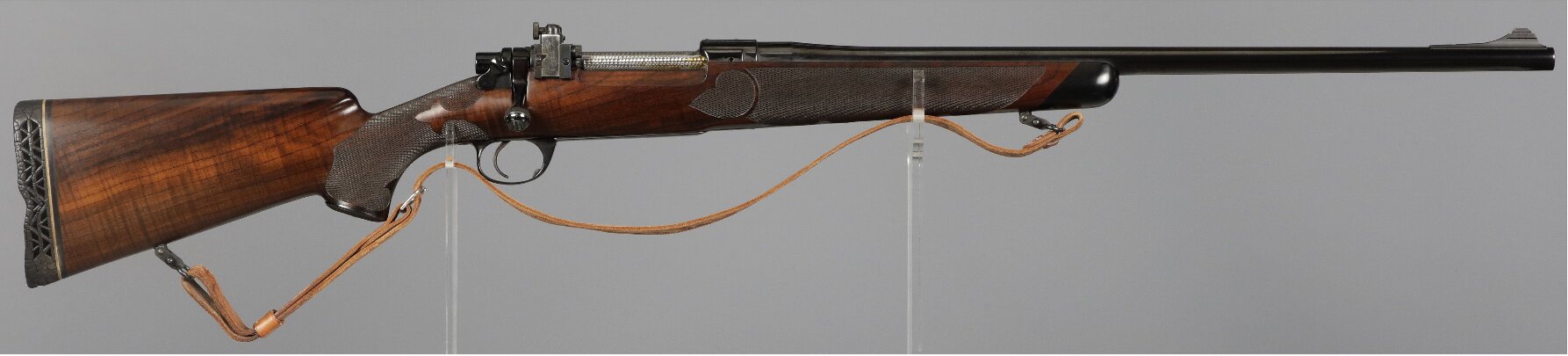
Dangerous Game Rifle in 378 Weatherby Magnum
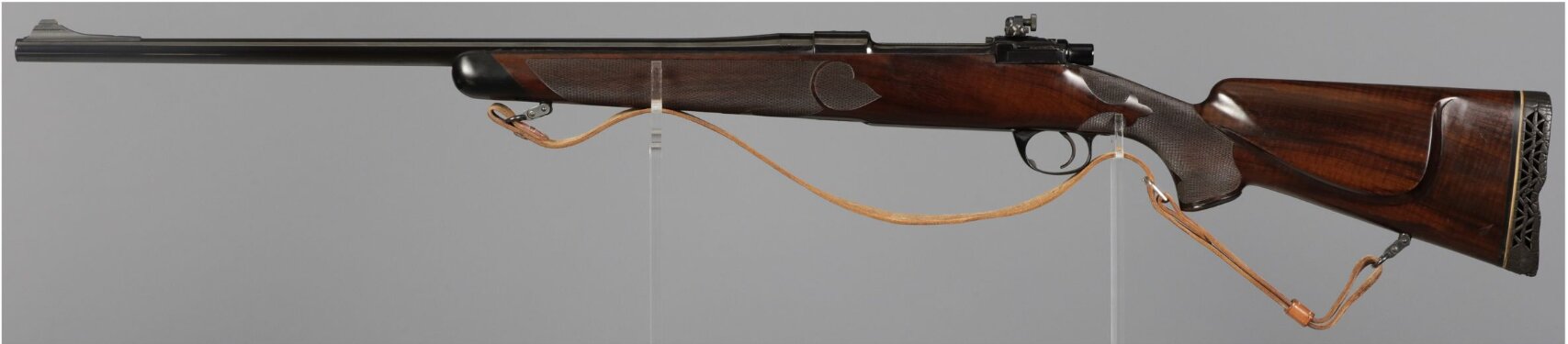
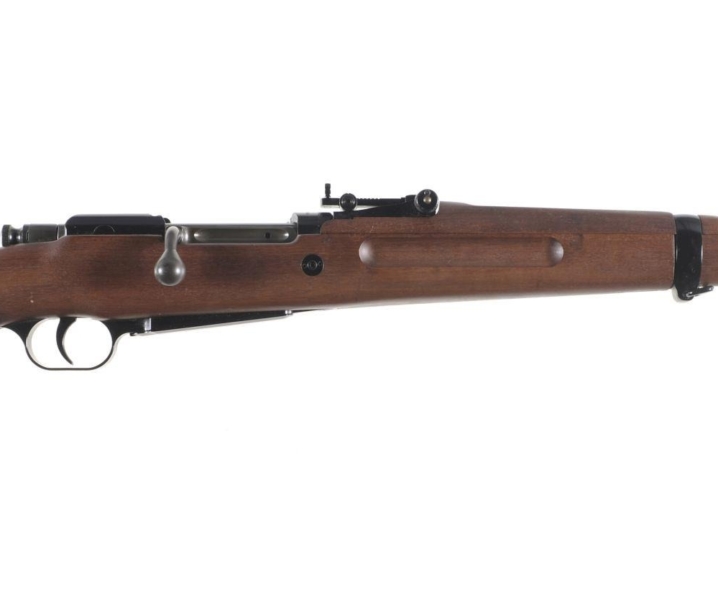
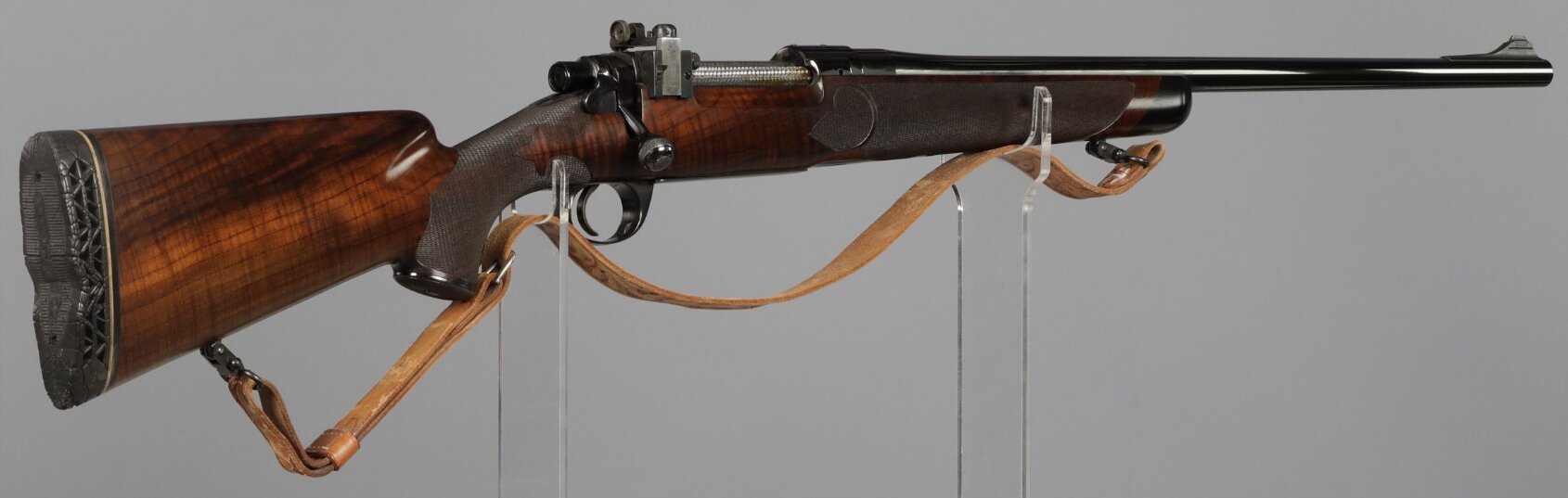
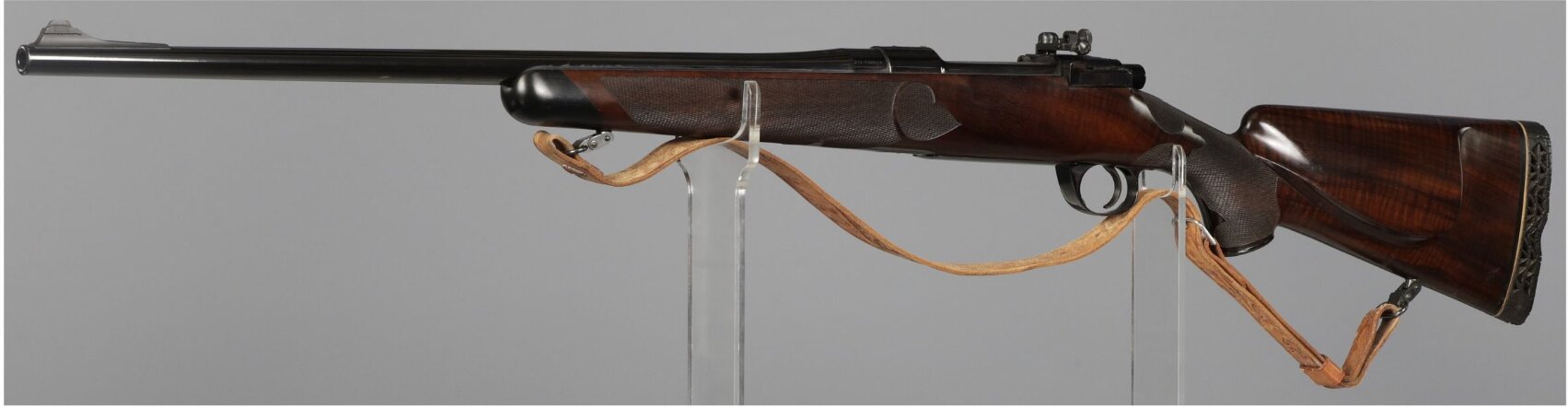
This Al Biesen dangrous game rifle is an outstanding example of his classic style. It is chambered for the 378 Weatherby Magnum and was made by Biesen in 1956. The action is a Remington Model 1917, a classic of that era. The Enfield Model 1917 action was used for creating dangerous game rifles chambered for the largest big game cartridges such as the 500 Jeffery (500 Schuler): so it was a perfect choice for the building of a 378 Weatherby.
This rifle’s stock is made in the Biesen classic style and has a cheek piece, ebony fore-end tip, and checkered steel pistol grip cap. It is made of walnut with a rather attractive character and has fleur-de-lis checkering in Biesen’s style.
The sights have been kept simple and durable, but effective, in line with the best that was available in that period. The rear sight looks to be a Lyman 48 peep sight which looks like it is fitted with the “Stayset” adjustment knobs as is appropriate for a hunting rifle. The front sight is a ramped blade.
The condition of the sale rifle is described by Rock Island Auction as follows:-
“Very fine overall as built by Al Biesen, with nearly all of the blue finish, some light handling evidence, compression of the recoil pad, and sharp checkering. Mechanically excellent.”
You will find the sale page for this rifle if you click here.
Weatherby FN-98 Rifle in 300 Holland & Holland Magnum
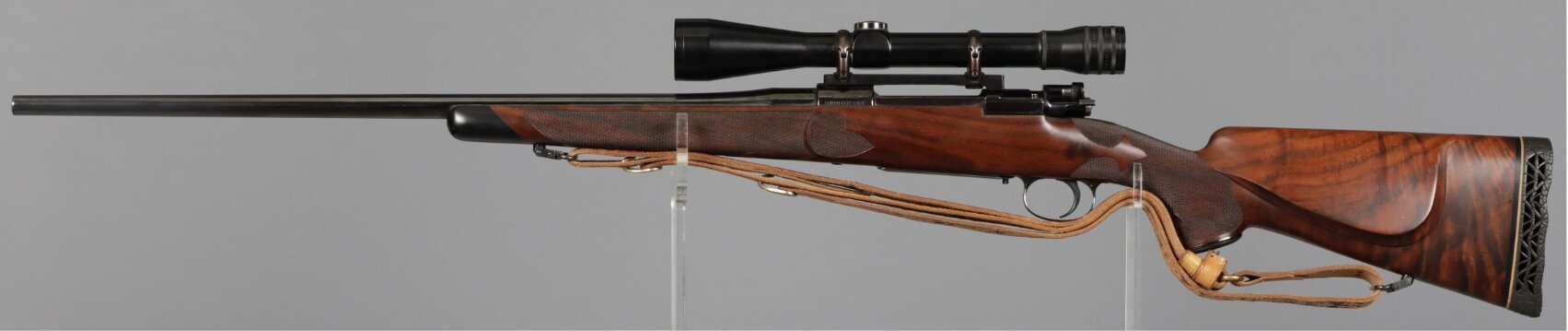
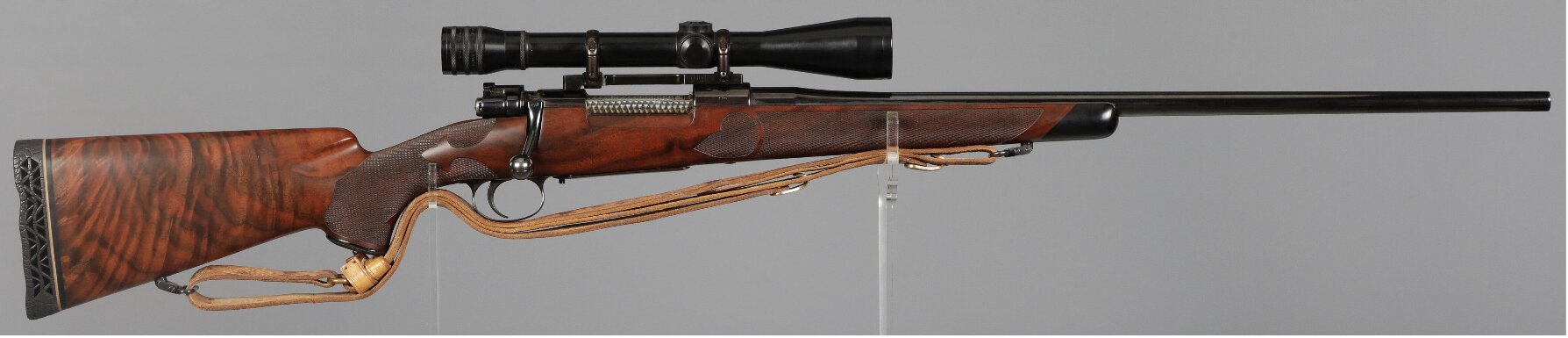
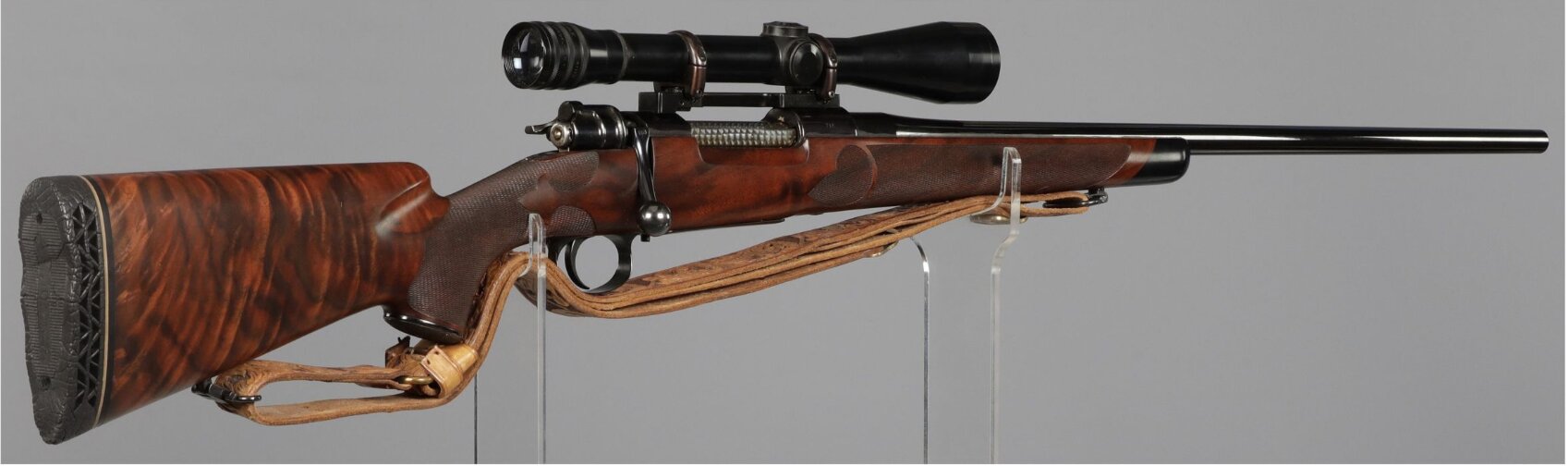
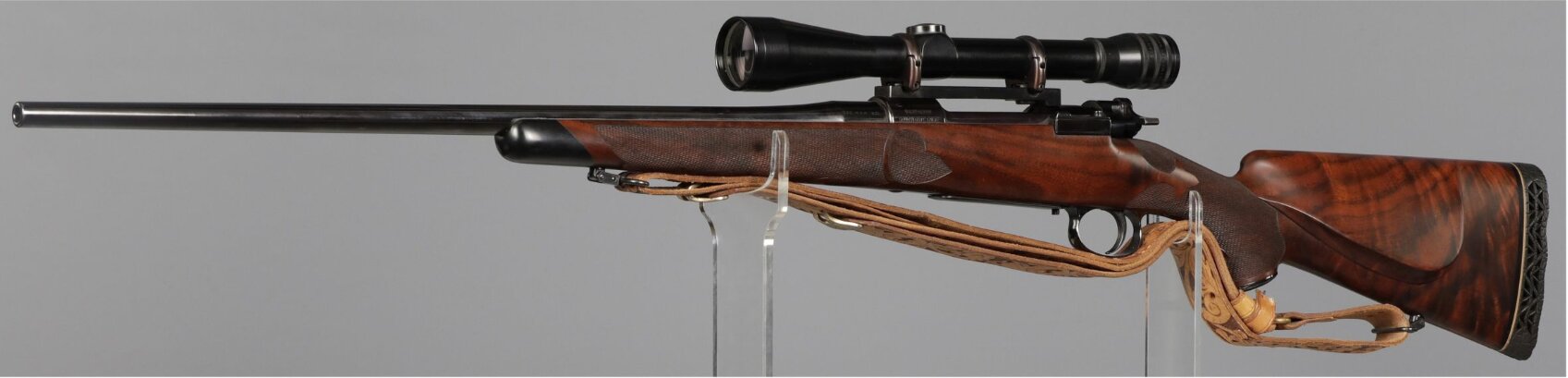
Back before Roy Weatherby created his Mark V multi locking lug action in 1958 he was creating his rifles on other available actions. In this “Southgate” era the most common was the Fabrique Nationale M98. Al Biesen created this 300 Holland & Holland rifle based on one of those FN Weatherby actions.
This rifle was made in 1956, and features a classic Biesen walnut stock with ebony fore-end tip and checkered steel pistol grip cap.
It is not fitted with open sights but instead wears a Kollmorgen Bear Cub 6x Double scope mounted in rather unusually profiled rings on a one-piece base.
The condition of this rifle is described by Rock Island Auction as follows:-
“Very fine overall as built by Al Biesen, with nearly all of the blue finish, light handling evidence, compression of the recoil pad, and sharp checkering. Mechanically excellent. The scope optics are clear.“
You will find the sale page for this rifle if you click here.
Al Biesen’s gunmaking business became a family affair with his son Roger joining his dad in the workshop in 1970, and Roger’s daughter Paula Biesen-Malicki joined the team as an engraver in the early 1990’s.
You can find more information on the family on their website if you click here.
Picture Credits: All pictures courtesy Rock Island Auction.

Jon Branch is the founder and senior editor of Revivaler and has written a significant number of articles for various publications including official Buying Guides for eBay, classic car articles for Hagerty, magazine articles for both the Australian Shooters Journal and the Australian Shooter, and he’s a long time contributor to Silodrome.
Jon has done radio, television, magazine and newspaper interviews on various issues, and has traveled extensively, having lived in Britain, Australia, China and Hong Kong. His travels have taken him to Indonesia, Israel, Italy, Japan and a number of other countries. He has studied the Japanese sword arts and has a long history of involvement in the shooting sports, which has included authoring submissions to government on various firearms related issues and assisting in the design and establishment of shooting ranges.