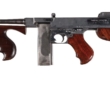
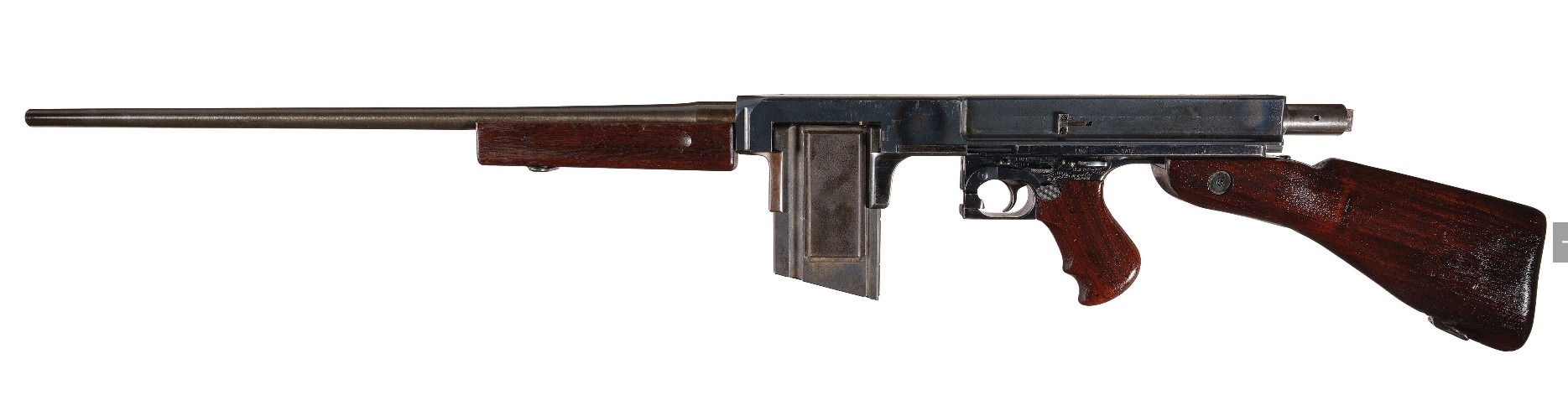
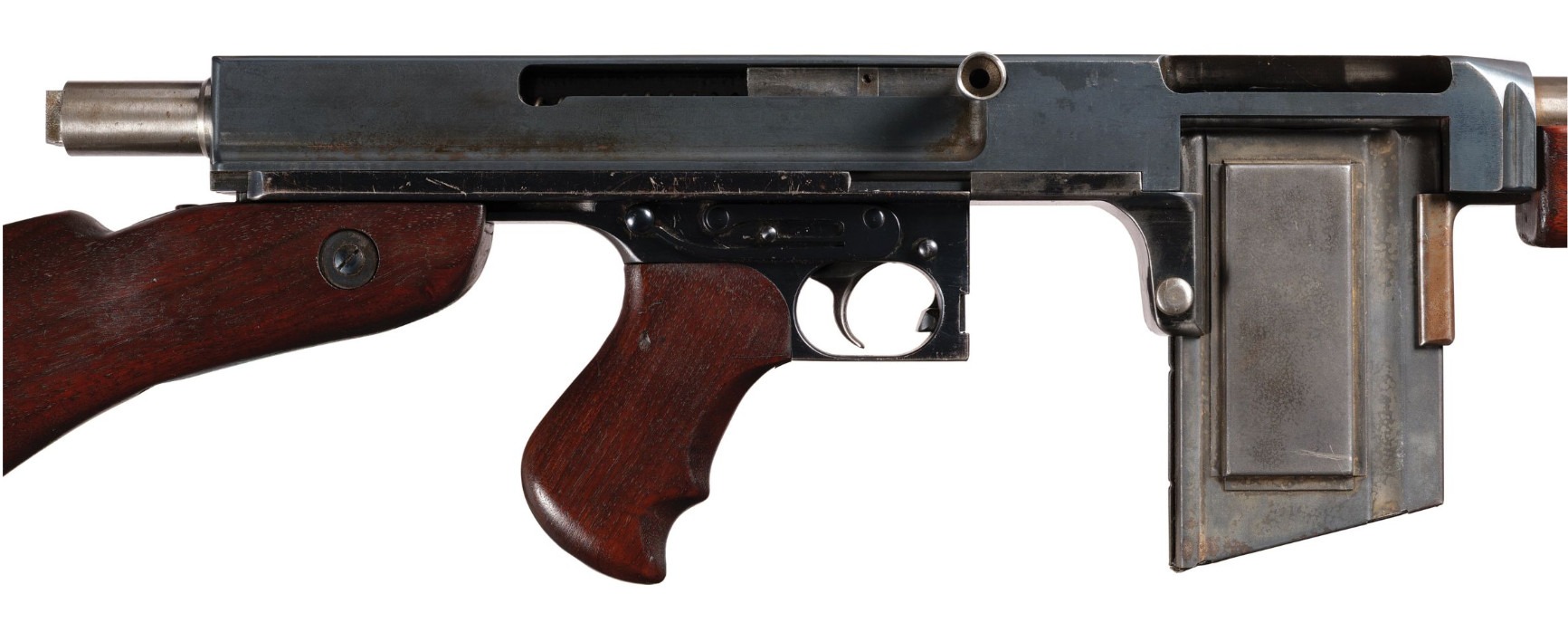
One of the most mysterious of the Thompson automatic guns is this prototype 30-06 chambered version which is based on the original Thompson Model 1921/1928 design but with a distinctly different method of delaying the blowback operation.
Fast Facts
- This Prototype 30-06 Thompson machine gun was based on the original J.T. Thompson design but changed significantly to enable it to use the 30-06 military rifle cartridge.
- Instead of the Blish Lock as used in the Thompson sub-machine gun this 30-06 prototype uses a two part bolt collet arrangement to cause the bolt to expand two bolt surfaces into firm contact with brass panels in the receiver body. This being intended to cause high resistance to the blowback force of the cartridge when discharged.
- This quite unique prototype has been in the collection of Mike Free and is now coming up for sale by Rock Island Auction on 6 December, 2025.
One of the most mysterious, and thus one of the most interesting of the “Thompson” automatic guns is the prototype designed for the U.S. 30-06 military cartridge.
Although the designer of the Thompson sub-machine gun, Brigadier General John T. Thompson, is not believed to have been involved in this project the designers sought to incorporate the Blish principle into the action in a way they hoped would enable a delayed blowback operation sufficient to efficiently use the 30-06 cartridge.
There is a rather significant difference between the 20,000psi chamber pressure developed by the Thompson’s 45ACP cartridge and the 50,000psi generated by the 30-06, so the mechanism that used the Blish principle for the sub-machine gun needed to be used in a rather different way.
The Blish principle used the theory that the friction developed under high pressure between two surfaces of unlike metals would be significantly greater than that generated between two surfaces of like metals.
This principle had been used by John T. Thompson in an “H” shaped Blish Lock in the Model 1921 and Model 1928 Thompson sub-machine guns but it was proven to be unnecessary to the action and so was omitted from the M1 and M1A1 simplified Thompson design.
But for the 30-06 Thompson machine gun the designers decided to attempt to use the unlike metal adhesion theory of John Bell Blish in a different way – one they thought would have a much stronger effect.
The inside of the receiver was fitted with brass pads that would act as adhesion surfaces. The bolt was a two-piece telescoping sleeved assembly.
Its easiest to imagine the start of the working of the action by envisaging the bolt open with the inner bolt extended out of the front of the outer bolt/sleeve.
When the bolt assembly is driven forward to battery by the recoil spring the inner bolt impacts against the breech face and is forced into the outer bolt/sleeve.
The outer bolt sleeve has slots cut into it so the slotted sections can be expanded outwards to engage on the brass friction pads on the inside of the receiver.
The inner bolt is tapered to act as a collet and as it is driven into the outer bolt/sleeve it forces two slotted segments into firm engagement with the two brass pads in the receiver to provide a high level of friction between the outer bolt and the receiver’s brass pads.
The end result of this design was what was effectively a delayed blowback automatic action.
The idea of using a collet in a rifle action to provide lock-up has been used by a number of designers with the straight pull rifles from Blaser being one. The difference with the Blaser being that the collet serves to actually lock the action in battery, not to depend on friction like the 30-06 Thompson.
There’s a good video on YouTube that shows the action of the 30-06 Thompson in operation which you can see if you click here.
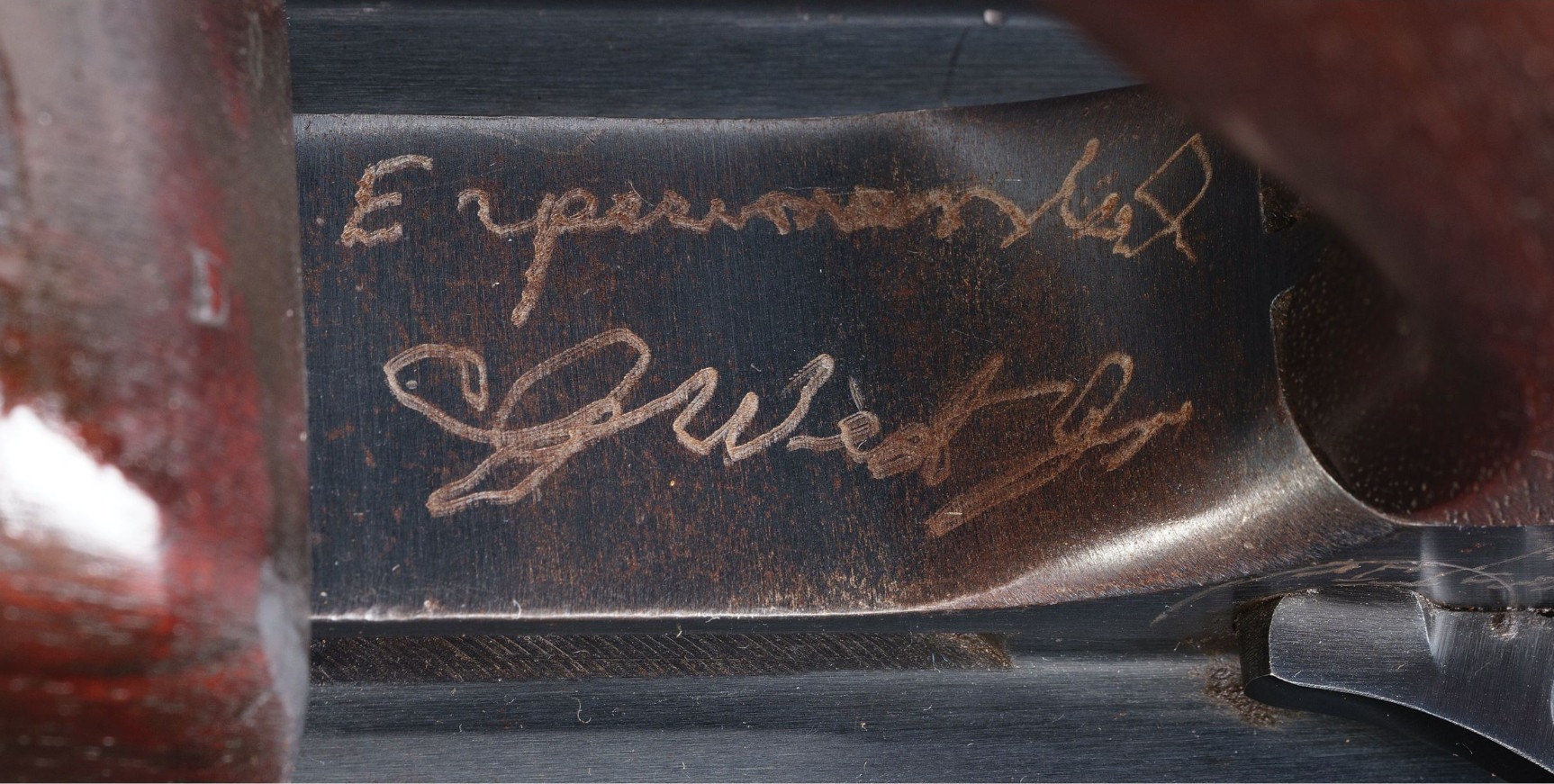
There is only one example of this prototype 30-06 Thompson machine gun which has resided in the collection of Mike Free and is now coming up for sale on December 6, 2025, by Rock Island Auction.
You will find the sale page for this Prototype 30-06 Thompson Machine Gun if you click here.
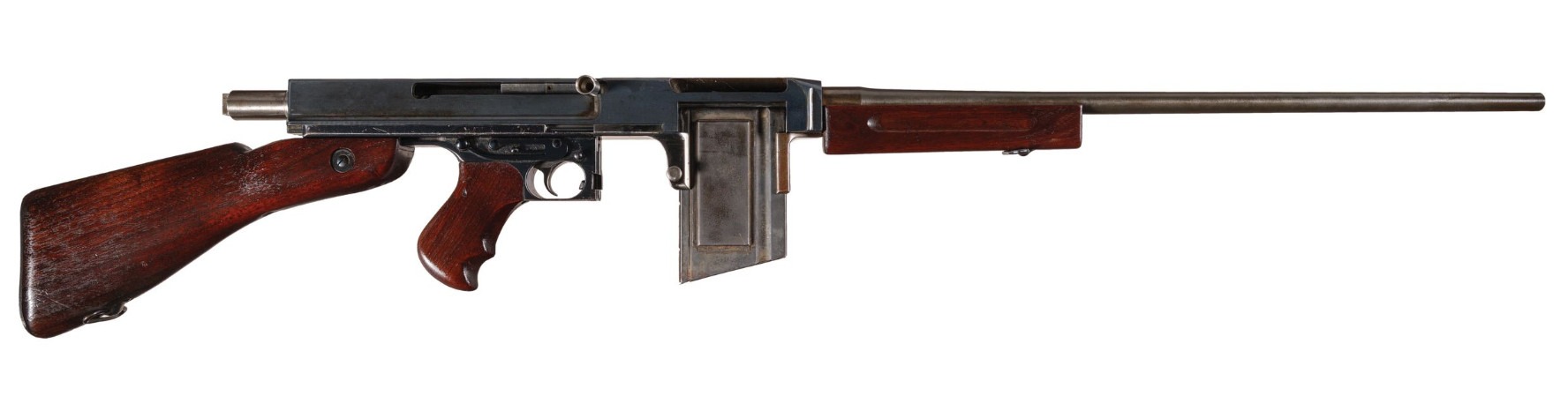
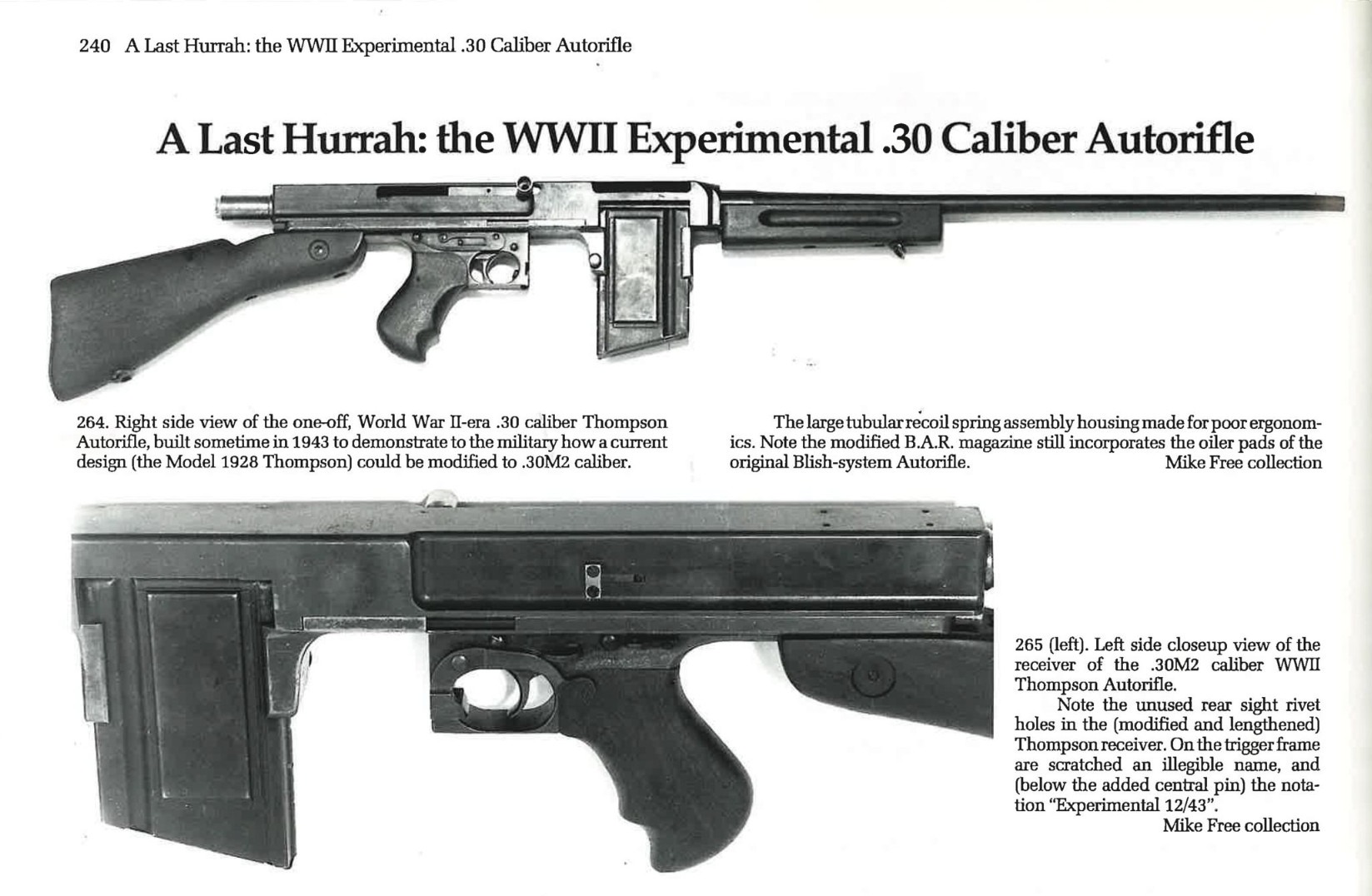
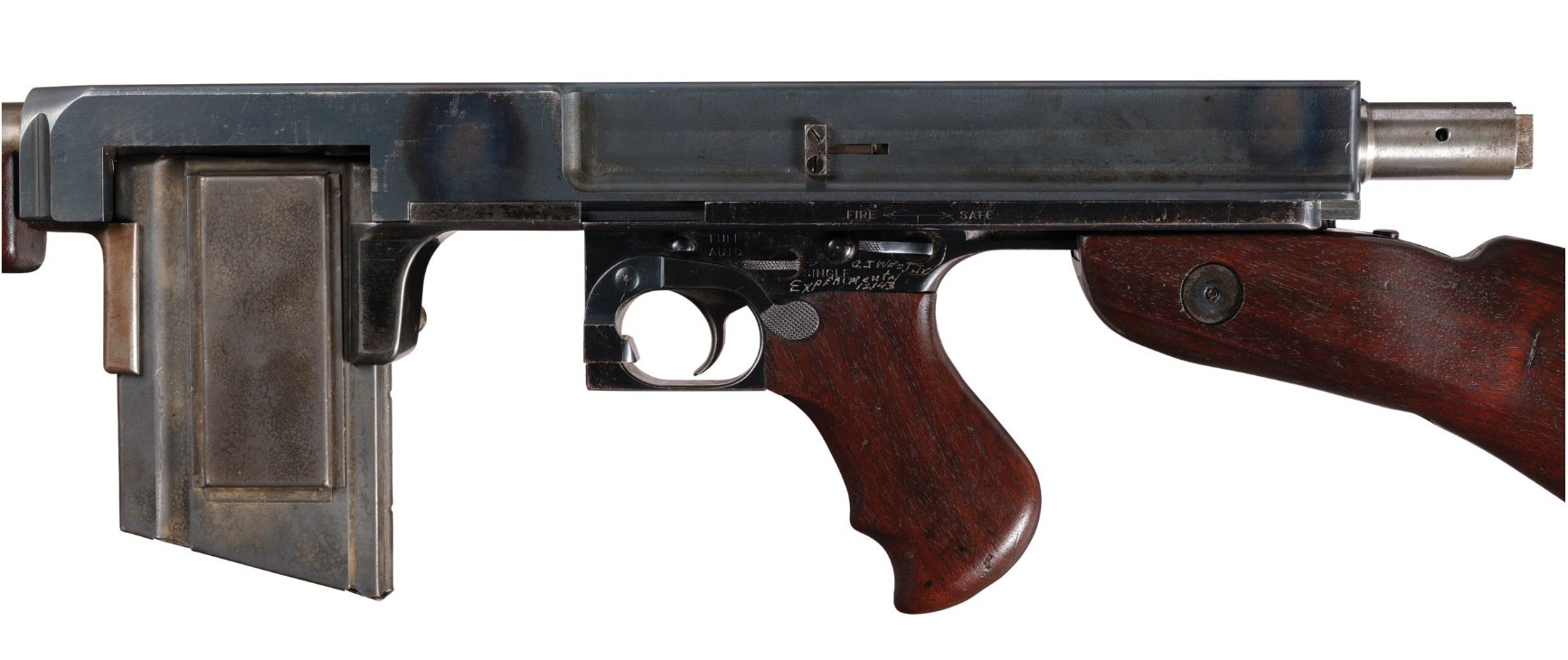
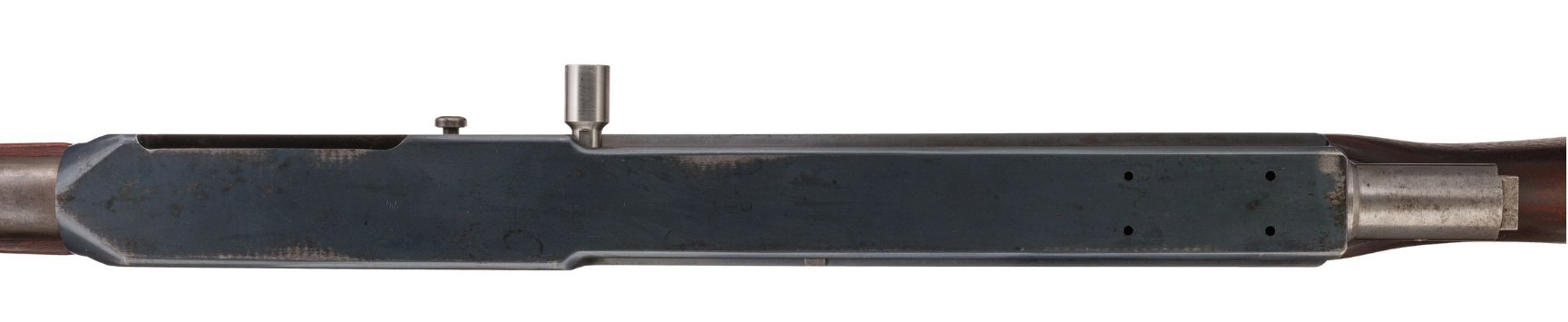
This machine gun has a right side charging handle and ejector port, receiver made in the Thompson style but increased in length to 17 inches long. It takes BAR magazines with the original magazine being fitted with side oiler pads, barrel is 23 inches long and of round profile. Weight is approximately 17 lb.
Rock Island Auction describe the condition of this item as follows:-
“Fine as a well made, well designed prototype using a combination of existing and fabricated components. The barrel and magazine retain 80% original parkerized finish, showing a mixed brown patina overall, with 80% original blue finish on the receiver and trigger housing, showing edge wear, rubbing and handling marks overall, and some heat spots on the receiver. One section of the bolt extension is absent. Stock is very fine, with scuffs and dents. There appears to be a component absent from the bolt to actuate the firing pin at the time of breech closure, otherwise mechanically functions. Further, while the combination of flange assemblies does create significant friction when the bolt is closed, no assurances can be offered that the resistance is sufficient for safe operation. NOTE: This weapon is a National Firearms Act (NFA), fully transferable Class 3, which is registered with the Bureau of Alcohol, Tobacco, Firearms and Explosives, (BATFE) that is classified as a “Curios or Relic” as defined in 27 CFR, 478.11. These weapons are still subject to the provisions of 18 U.S.C. Chapter 44 and 27 CFR part 479.“
This unique design prototype is fascinating given its unique design and the attempt to incorporate the Blish principle by use of a collet system to greatly increase the friction to delay the blowback operation. It represents perhaps the last attempt to do this, and a last attempt to design a machine gun based on John T. Thompson’s original designs.
Jon Branch is the founder and senior editor of Revivaler and has written a significant number of articles for various publications including official Buying Guides for eBay, classic car articles for Hagerty, magazine articles for both the Australian Shooters Journal and the Australian Shooter, and he’s a long time contributor to Silodrome.
Jon has done radio, television, magazine and newspaper interviews on various issues, and has traveled extensively, having lived in Britain, Australia, China and Hong Kong. His travels have taken him to Indonesia, Israel, Italy, Japan and a number of other countries. He has studied the Japanese sword arts and has a long history of involvement in the shooting sports, which has included authoring submissions to government on various firearms related issues and assisting in the design and establishment of shooting ranges.