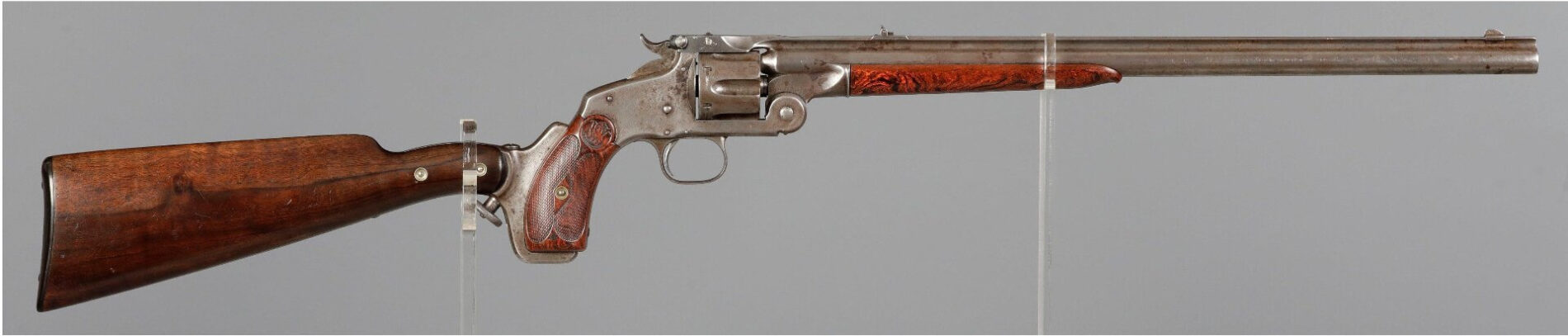
The Smith & Wesson Model 320 was a revolving carbine created and offered by Smith & Wesson in 1879, which was a time when the revolving carbine had already become obsolete. Although the model did not sell well it went on to become a sought after collector’s item.
Fast Facts
- The Smith & Wesson Model 320 revolving rifle was based on the successful Model 3 revolver.
- The Model 320 was chambered for the unique proprietary 320 Smith & Wesson Rifle cartridge.
- Only 977 examples of the Model 320 were produced, making it one of the more rare Smith & Wesson firearms, and so of great interest to collectors.
- One of these Model 320 revolving rifles is for sale by Rock Island Auction at time of publication.
The Smith & Wesson Model 320 was a revolving rifle based on the successful Model 3 top break revolver and entered production in 1879, being made until 1887.
In some respects it is a bit of a mystery how this model found a market when it had to compete with the lever action Winchesters and various others, and against the Colt Lightning pump actions. But find a market it did – albeit a very limited one.
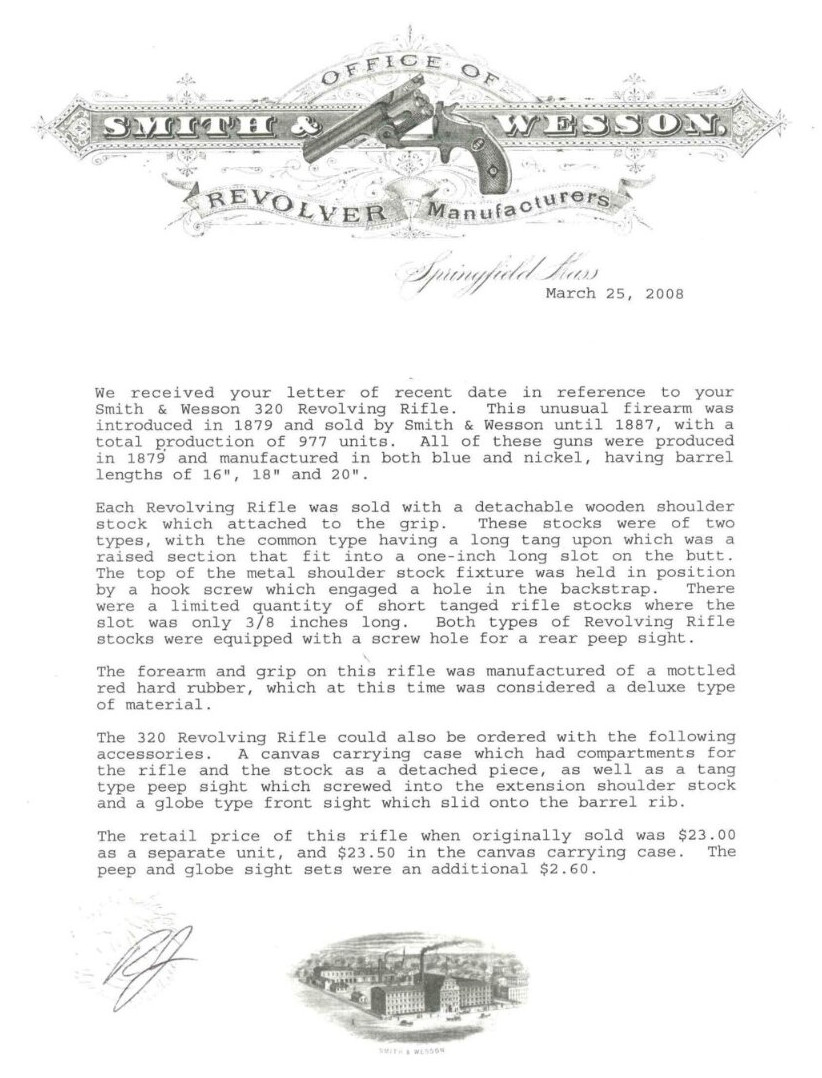
The Model 320 was made with refinements to the original Model 3 and featured longer barrels than were provided on the Model 3 revolvers. Barrel lengths were 16 inch, 18 inch, and 20 inch.
As I understand it, Smith & Wesson did not at the time have the tooling that would enable them to create these barrel lengths as one piece with the top strap and barrel assembly, and so the top strap assembly had the barrel screwed into it.
The end result was for a smooth invisible joint so it looked as if the whole thing was one piece.
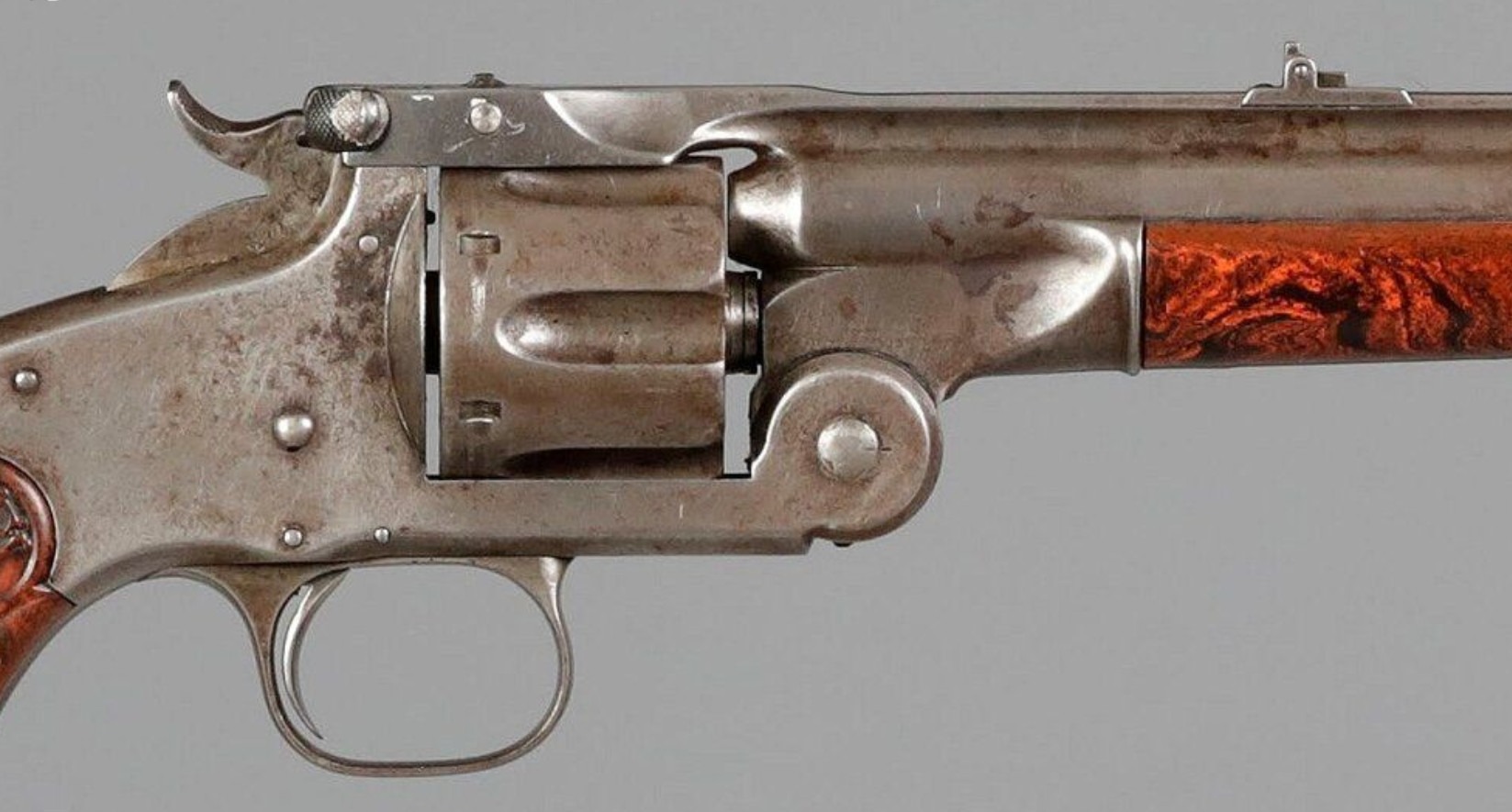
The barrel of the Model 320 was fitted with a prominent rib with the rear sight fitted into it over the barrel just ahead of the action, and the front sight fitted on the rib near the muzzle.
As an option the Model 320 was offered with a peep sight complimented by a globe front sight.
The Model 320 was made chambered for a unique 32 caliber cartridge designated the 320 Smith & Wesson Rifle. This cartridge fired a 98-100 grain inside lubricated lead bullet with a black powder charge of 17 grains. This achieved a velocity of approximately 1,200 fps and muzzle energy of 319 ft/lb.
The rifle’s shoulder stock was made removable so it could be transported and stored more easily. It also meant that it could be concealed if needed.
The Model 320 would still suffer from the same issue of cylinder gap that all revolvers (other than the Russian gas seal Nagant) present with. So if the shooter fired the rifle while holding the fore-end there would be the hot flame projected through the cylinder gap to contend with. Gauntlet style gloves might have been needed to counter this. Such gloves were common for military and police in that period, and for civilians also.
The Model 320 qualifies as a bit of a mystery gun: the revolving carbine had long since been superseded by the lever and pump action carbines that had come to dominate in the post civil war United States. So we are left to wonder why Smith & Wesson designed it and put it into production.
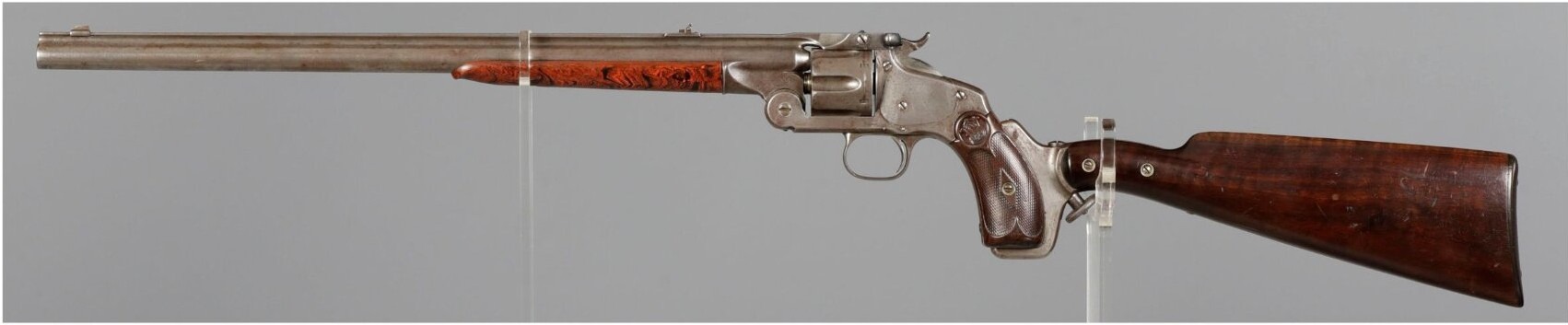
Sales of the rifle were slow with a total of only 977 being made. Of these 239 were made with the 16 inch barrel, 514 with the 18 inch barrel, and 224 with 20 inch barrels.
Very few found their way overseas: 65 were exported to Britain, 36 to France, and 24 to Australia.
These things add together to make the Smith & Wesson Model 320 a rather rare item, and thus the model is quite prized by collectors.
One of these revolving rifles is for sale by Rock Island Auction at time of publication. The sale rifle is fitted with an 18 inch barrel and is described by Rock Island Auction as follows:-
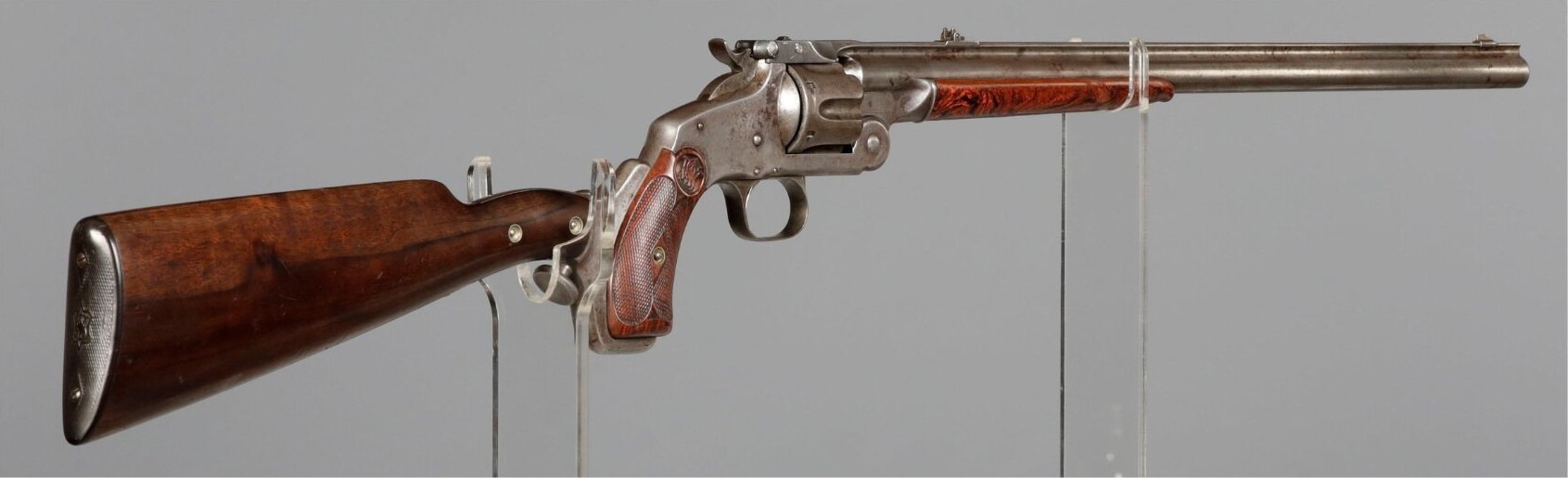
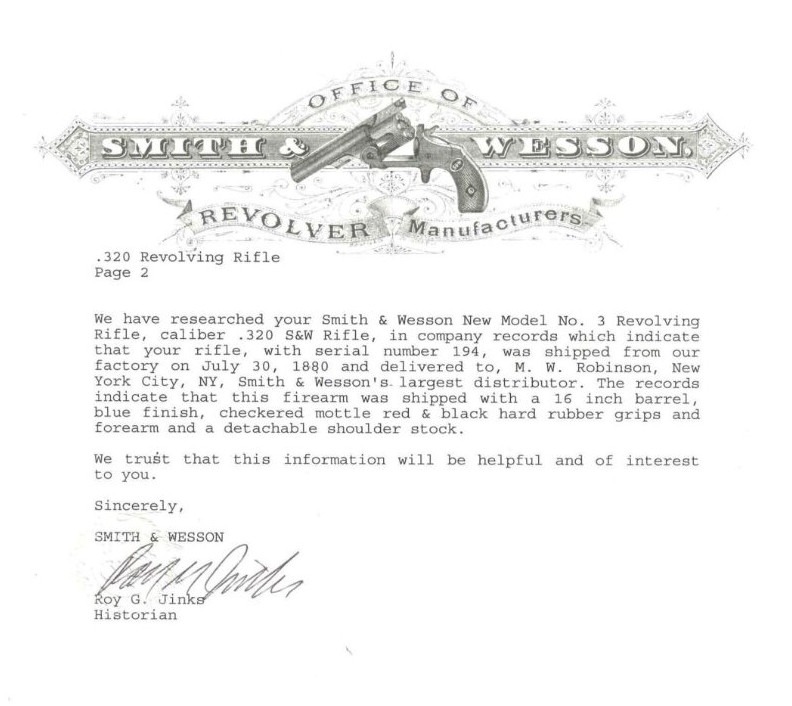
“Manufactured from 1879 to 1887, the Model 320 revolving rifle is one of the rarest Smith & Wesson firearms produced with a total production of 977. These firearms were serial numbered from 1 to 977 and out of the 977 manufactured, 514 had the 18 inch barrel. Factory letter states this Model 320 was shipped on July 30, 1880 and delivered to M.W. Robinson of New York City with a 16 inch barrel, blue finish, checkered mottled red and black hard rubber grips and forearm, and detachable shoulder stock. The 18 inch barrel is numbered to the gun, indicating that the 16 inch barrel length listed in the factory letter is most likely in error. The cylinder and barrel latch are also numbered to the gun“
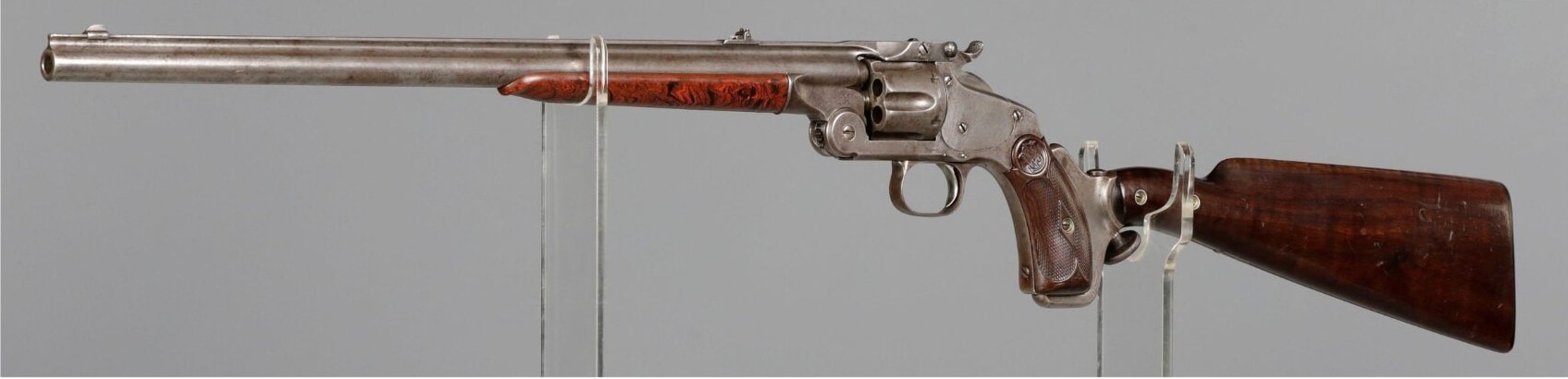
The condition of the rifle for sale is described by Rock Island Auction as follows:-
“Good overall with grey patina, pitting, smooth checkering on forearm and left grip panel, and mostly distinct checkering on right grip panel. Stock is good with dings and scratches. Mechanically functions.”
You will find the sale page for the pictured Model 320 revolving rifle if you click here.
Picture Credits: All pictures courtesy Rock Island Auction.

Jon Branch is the founder and senior editor of Revivaler and has written a significant number of articles for various publications including official Buying Guides for eBay, classic car articles for Hagerty, magazine articles for both the Australian Shooters Journal and the Australian Shooter, and he’s a long time contributor to Silodrome.
Jon has done radio, television, magazine and newspaper interviews on various issues, and has traveled extensively, having lived in Britain, Australia, China and Hong Kong. His travels have taken him to Indonesia, Israel, Italy, Japan and a number of other countries. He has studied the Japanese sword arts and has a long history of involvement in the shooting sports, which has included authoring submissions to government on various firearms related issues and assisting in the design and establishment of shooting ranges.