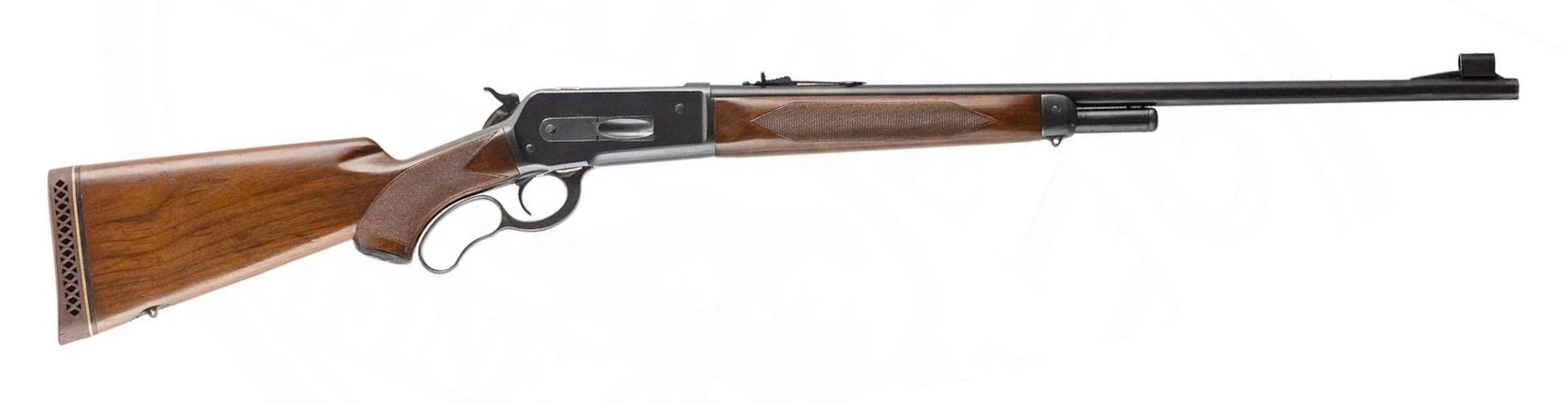
The Winchester Model 71 is one of the most outstanding of John Moses Browning’s lever action rifle designs. It brought with it the 348 Winchester cartridge which was a superb medium bore perfect for woods hunting throughout North America.
Fast Facts
- The Winchester Model 71 was created at the same time as the Winchester Model 70 and they were complimentary designs, each designed for a different role: the Model 70 for longer range high accuracy shooting and the Model 71 for short to medium range woods hunting.
- The Model 71 was made as a lever action medium bore with the capability to replace a range of cartridges including the 33 WCF and 405 Winchester. To accomplish this Winchester created the 348 Winchester cartridge.
- The Model 71 was an improved version of the black powder Winchester Model 1886 and is regarded as one of the best examples of John Moses Browning’s lever action rifle designs.
The story of the Winchester Model 71 runs parallel with that of the Winchester Model 70. Both the Model 70 and Model 71 were designed and entered production around the same time, the Model 71 in 1935, and the Model 70 in 1936.
This parallel development reflects a debate that was going on in Winchester’s management that had been ongoing prior to the United States entering the First World War. Winchester’s Vice President Frank G. Drew fervently believed that the American sportsman was not the slightest bit interested in anything other than a lever-action rifle.
Frank G. Drew had voiced his opposition to Winchester creating a bolt-action sporting rifle and was in all probability only persuaded to relent when Winchester’s main rival, Remington, introduced their bolt-action rifle based on the M1917 Enfield. Frank G. Drew saw that those Remington bolt guns were selling like little hotcakes, and so he changed his mind – a bit.
What Frank G. Drew had not anticipated was that there were large numbers of American servicemen who had used the 1903 Springfield on the battlefield had returned home wanting to keep using the bolt-action style rifles they had trained and gained experience with in the army.

This desire of returned servicemen to want to go hunting with a rifle like the ones they were familiar with in the military is happening today. So many young ex-servicemen hunters prefer the AR-15 style rifles so they have begun to qualify as a “modern sporting rifle”. While the style of rifle preferred by people like me of the older generation, bolt-action rifles with gorgeous walnut stocks and older style telescopic sights, are commonly being shunned by the young generation of sporting shooters.
For the ex-servicemen of the 1930’s the bolt-action rifle was the one they’d used in combat. And so it was that Winchester began the process of creating their own bolt-action sporting rifle – a journey that would give to the world the “Rifleman’s Rifle”, the Winchester Model 70.
You will find the Revivaler history of the Winchester Model 70 if you click here.
Frank G. Drew was, sadly, killed in a motor accident in October 1928 but his influence continued at Winchester, a company he had done so much to shape, and in the years after his passing Winchester’s leadership and engineers embarked on the creation of a lever-action rifle that would combine the loved features of Winchester rifles, the lever-action, tube magazine with side loading gate, and exposed hammer with no safety catch.
To create this new model the engineers based it on one of the most highly respected of Winchester’s former models, the John Moses Browning designed Model 1886. But they made some subtle changes to turn it into a twentieth century rifle and they chambered it for a new smokeless twentieth century cartridge, the 348 Winchester.
Winchester had made the Model 1886 chambered for the 33 WCF, which was based on the common 45-70 cartridge case necked down to accommodate .338″ bullets. This cartridge was made between 1902-1940.
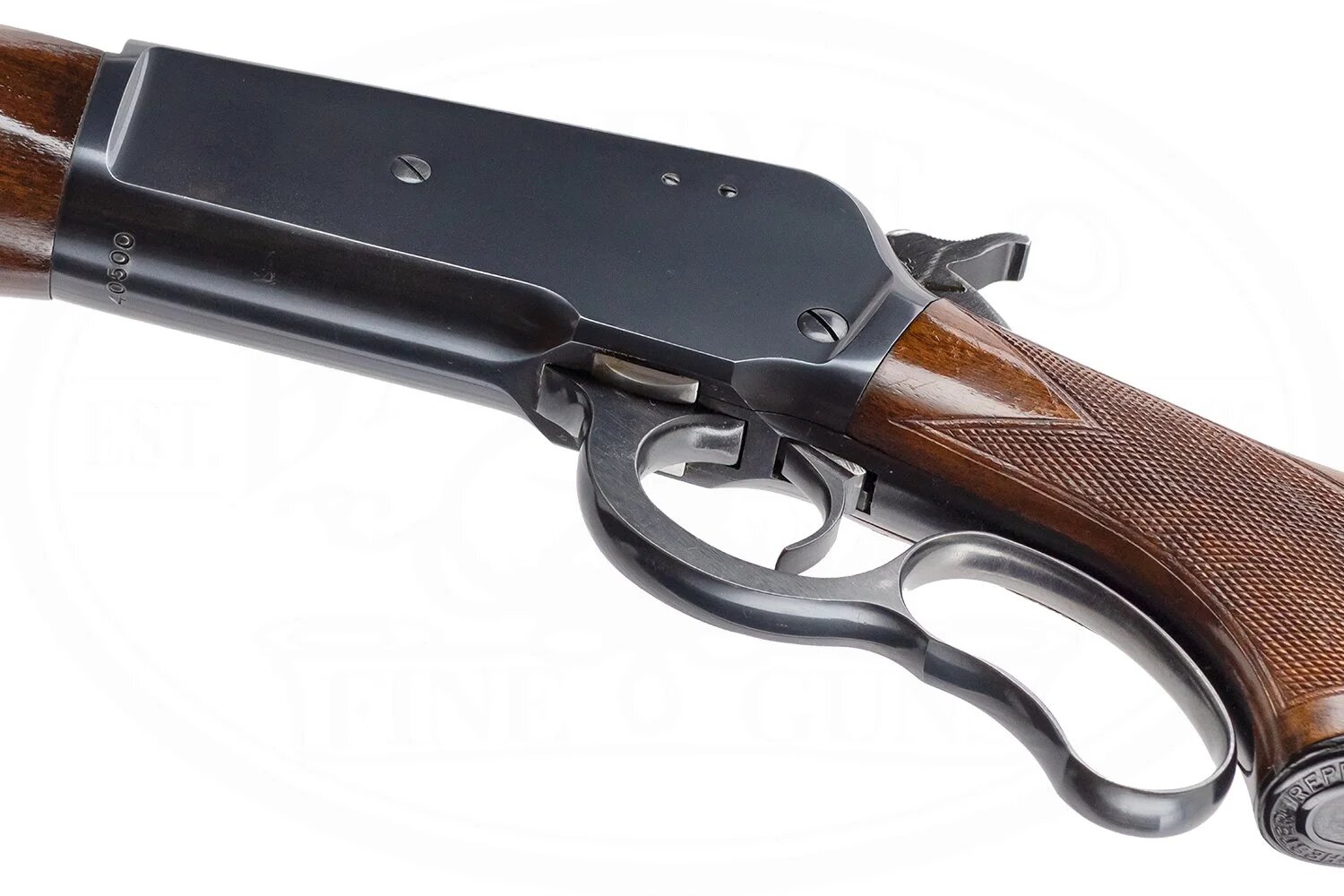
Both the Model 1886 and the 33 WCF proved to be good for hunting in short to medium range settings for deer and black bear, but there was room for improvement and the new Winchester Model 71 and the 348 Winchester cartridge were made to deliver those improvements.
The Model 71 was created to supersede the Model 1886 and Teddy Roosevelt’s favorite, the Model 1895. It was created to be a woods rifle, agile and fast handling, and able to deliver repeat shots at a pace that a bolt-action cannot replicate, and it was chambered for a cartridge that could handle any game in North America up to and including the big and often rather grumpy bears that inhabit the far north.
The Model 71 was also conceived to be a rifle that might find a place in a gun rack next to a Model 70: so a hunter might have a bolt-action Model 70 for longer range hunting, and a lever-action Model 71 for the woods.
The changes made to the Model 1886 action to turn it into the new Model 71 were subtle but effective. The hammer spring was changed to a coil spring, and the geometry of the internal action parts was given some fine tuning.
Instead of being angled straight up as on the Model 1886 the locking lugs were set sloping slightly rearward and shaped to ensure an even more smooth cycling of the action. An additional benefit to the slight rearward angle of the locking lugs of the Model 71 was that if the rifle was fed a load that was a tad hot for it the shooter would feel feedback in the lever ring.
The Model 1886 was designed to accommodate the black powder 50-110, on which the 348 Winchester was based, but the 348 Winchester was a bit shorter and so the Model 71 action was made for that shorter cartridge, and that shortening helped to make the action both smooth and convenient.
The design of the 348 Winchester cartridge played a significant role in the smoothness and reliability of the Model 71’s action. The case was very tapered and so, there being a large diameter chamber mouth for it to be pushed into it presented the best possible profile for chambering, and for extraction and ejection.
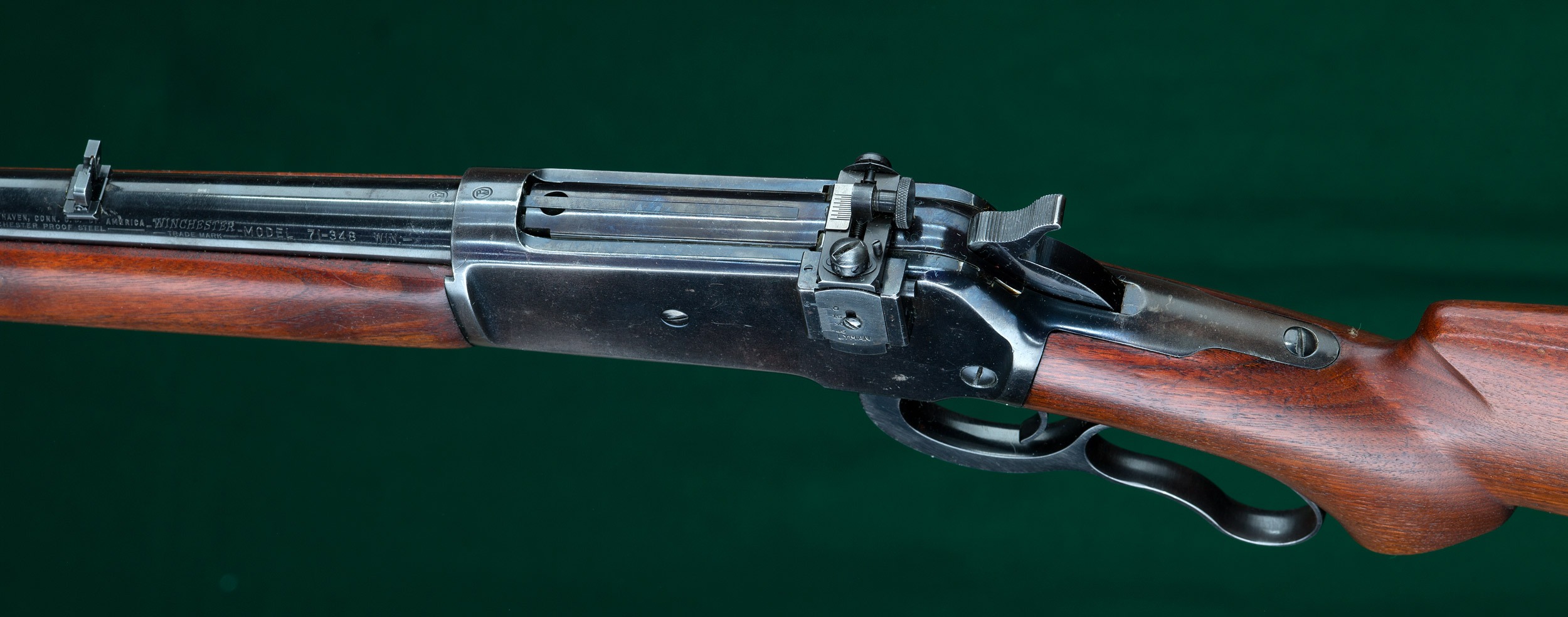
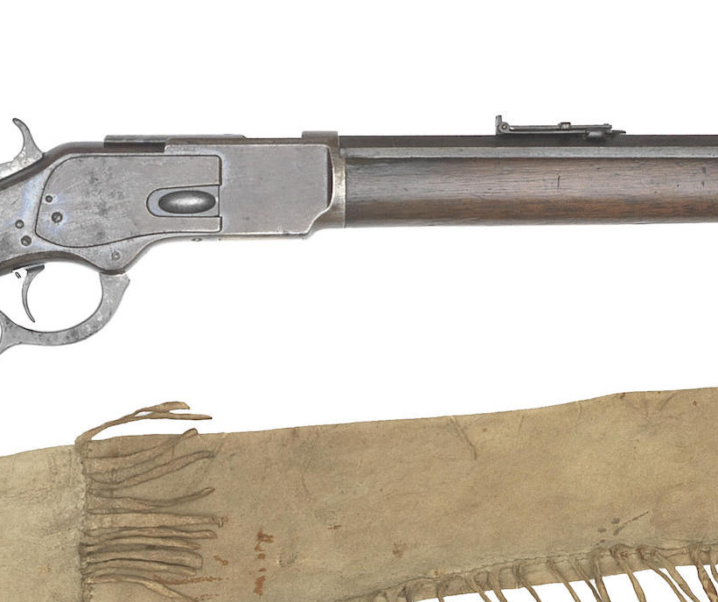
Winchester did not seem to consider that the top eject of both the Model 1886 and the new Model 71 was a roadblock to fitting a telescopic sight. Telescopic sights were only beginning to be fitted to hunting rifles in this era. Most hunting rifles were fitted with conventional open sights, in the case of the Model 71 that was the Lyman 22K. Those seeking more accuracy tended towards aperture sights that were readily available, either bolt mounted, tang mounted, or in later rifles the Lyman Model 56 which was mounted on the receiver.
The first version of the Model 71 was referred to as the “deluxe model” and was fitted with a 24 inch round tapered barrel with a hooded ramp foresight. Mounted underneath that barrel was a three quarter length four shot tube magazine.
In 1936 Winchester introduced a short barrel version with a 20 inch round barrel, this sometimes being referred to as a “carbine” model.
The early production Model 71’s were fitted with a tang measuring 3⅞ inches long. There were approximately 15,000 of these made. After that the tang length was reduced to 2⅞ inches: so the older versions are referred to as “Long Tang” and the later as “Short Tang”.
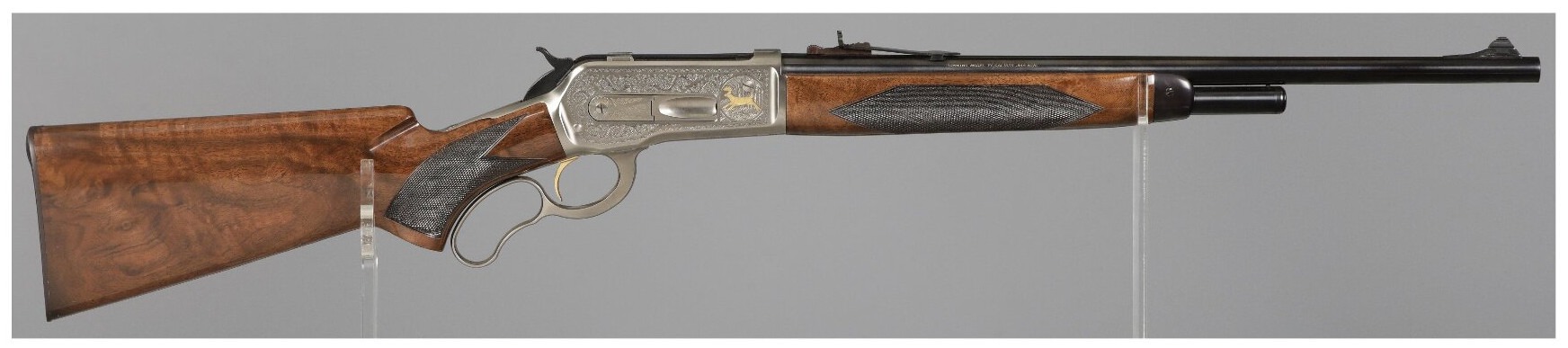
Winchester Model 71’s can of course be encountered with various styles of finish and/or engraving.
Weight of a 24 inch barrel rifle was listed at 8.8lb empty and 9.3lb loaded with five rounds with 250grain bullets.

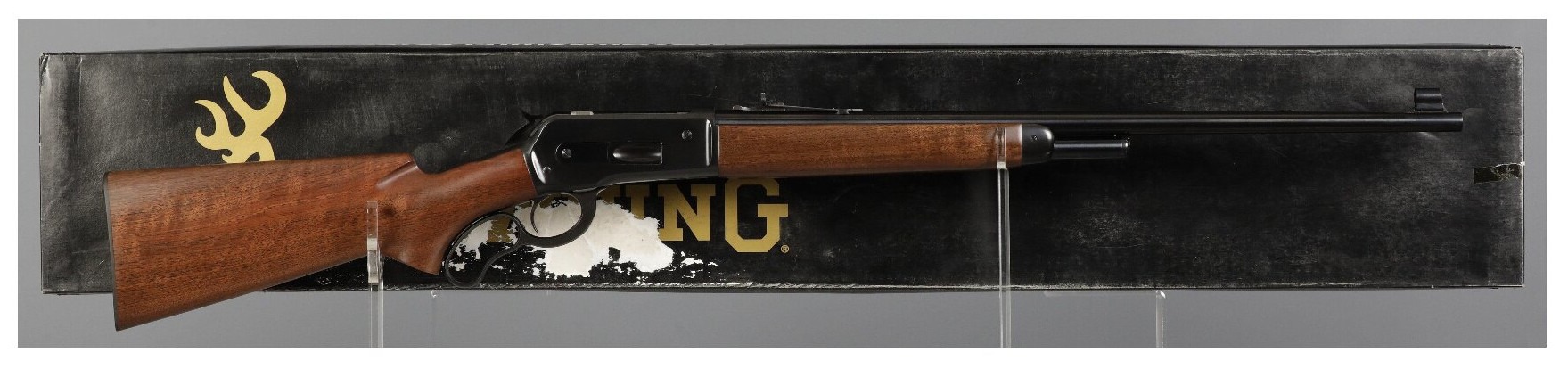
The Winchester Model 71 was originally in production from 1935-1958 with approximately 47,000 being made. It was resurrected as the Browning Model 71 in 1987 for a limited production run of between 13,000-16,000.
The Browning Model 71 is also a superbly made rifle but despite its being made to what appears to be the same design as the Winchester there are differences between the two and parts are not interchangeable between them as I understand it.
The 348 Winchester cartridge is itself an interesting item. It fires as .348″ bullet which is a unique size: and the case was based on the black powder 50-110 which is also pretty unique.
The ballistics of the 348 Winchester are similar to the 35 Whelen, and indeed it is said by some that Col. Townsend Whelen was consulted on the design of the Model 71 and had some input.
The 348 Winchester was offered in three bullet weights:-
- 150 grain (10 grams) @ 2,890 fps (880 m/s) with energy of 2,780 ft/lb.
- 200 grain (13 grams) @ 2,530 fps (770 m/s) with energy of 2,840 ft/lb.
- 250 grain (16 grams) @ 2,630 fps (800 m/s) with energy of 3,072 ft/lb.
The bullet diameter and ballistics are similar to the old European favorites that are still in use today: the 9.3×62 and the 9.3x74R.
Just like the 35 Whelen, the 348 Winchester is regarded as a very capable medium bore cartridge, making the Model 71 a capable medium bore rifle. It is indeed among the last and most interesting of John Moses Browning’s lever action rifle designs.
Picture Credits: Feature image at the head of this post is a Winchester Model 71 Deluxe with checkered stock and steel pistol grip cap, courtesy stevebarnettfineguns.com. Other pictures courtesy stevebarnettfineguns.com, hallowellco.com, Rock Island Auction, as individually credited.
Jon Branch is the founder and senior editor of Revivaler and has written a significant number of articles for various publications including official Buying Guides for eBay, classic car articles for Hagerty, magazine articles for both the Australian Shooters Journal and the Australian Shooter, and he’s a long time contributor to Silodrome.
Jon has done radio, television, magazine and newspaper interviews on various issues, and has traveled extensively, having lived in Britain, Australia, China and Hong Kong. His travels have taken him to Indonesia, Israel, Italy, Japan and a number of other countries. He has studied the Japanese sword arts and has a long history of involvement in the shooting sports, which has included authoring submissions to government on various firearms related issues and assisting in the design and establishment of shooting ranges.