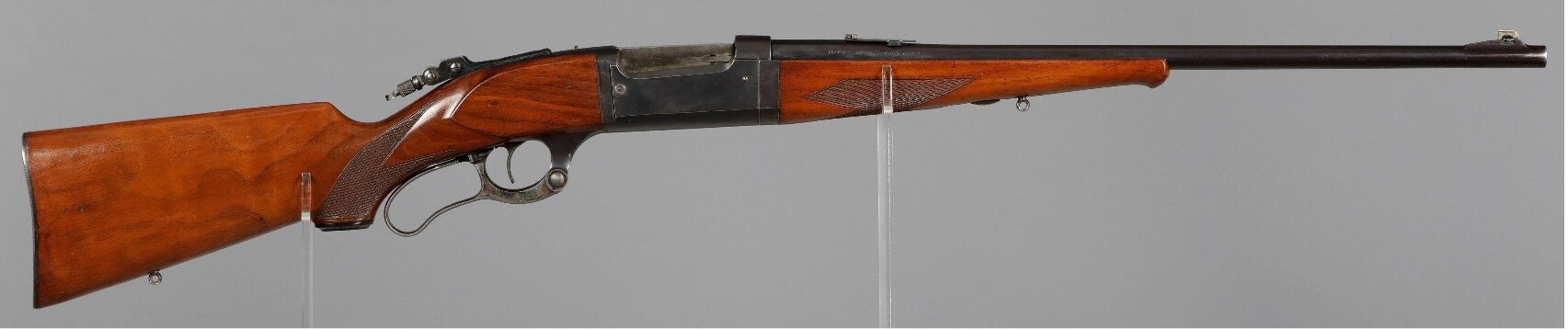
The Savage Model 1899 and later Model 99 became iconic American hunting rifles. Their design was modern and intelligently thought out and they remained in production for almost a century.
Fast Facts
- The Savage Model 1899 and later Model 99 were created by Jamaican born British citizen Arthur William Savage in collaboration with his son Arthur John Savage.
- The father and son team designed their first prototype lever-action rifle in 1892, and then did a new design which entered production as the Savage Model 1895.
- The Savage Model 1899 was a refinement of the Model 1895 and the two were very similar.
- The Model 1899 was unusual at the time of its creation in being striker fired and having a rotary magazine with cartridge load count indicator.
The Savage Model 1899, later called the Model 99, proved to be an iconic American rifle, one that survived and prospered in production from 1899-1997: an almost century long production run. And when a rifle manages a feat like that it is certain that the designers and manufacturers got everything right.
The creator of the Savage Model 1899 was a Jamaican born British man named Arthur William Savage. Savage was an adventurer and entrepreneur. Savage was born in 1857 and in the late 1880’s when he was in his thirties he took his family to Australia looking for adventure and to hopefully make his fortune. Australia had been home to a number of gold rushes and perhaps it was a lure that persuaded Savage to take the risk and move there, but he finished up buying a cattle station and trying his luck at being a pastoralist.
In Australia a “cattle station” is what Americans would call a ranch, and they were established in the outback bushland, in country where planting crops would be an impossible enterprise but where cattle or sheep could graze on the native vegetation.
To enable this required a large land area, and the putting down of wells or bores to bring artesian water up to the surface for the stock.
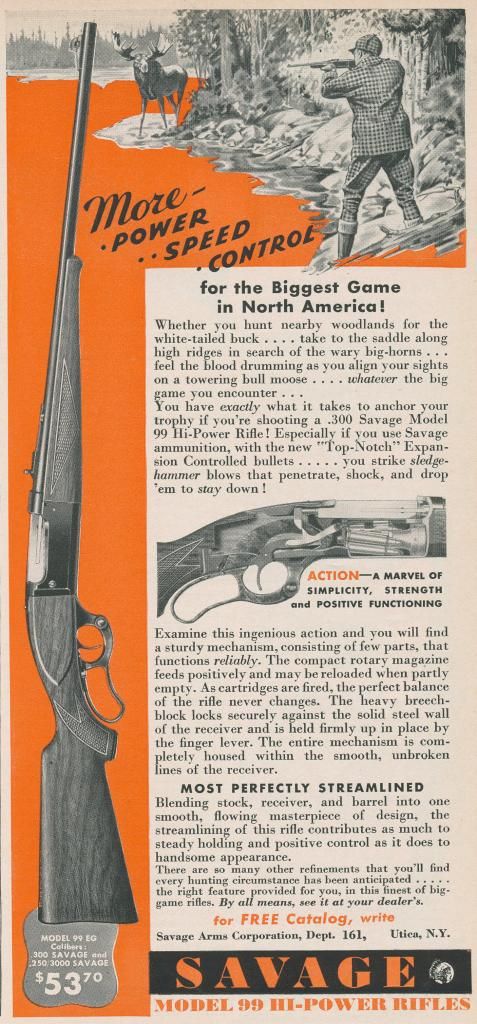
During this time Savage and his son Arthur John Savage set about designing a rifle. Their first prototype was created in 1887 and featured a magazine located in the stock.
Savage and his family gave the cattle station enterprise their best shot but after eleven years decided to sell up and move back to Jamaica where he bought a coffee plantation.
1892 saw Savage re-locate again, this time to New York where he worked for the Utica Belt Line Street Railroad and also got part time work at the Utica Hammer Magazine Company, which was a gun factory.
It was during this time that Savage and his son created a new lever action rifle design in 1895. This rifle was made to use the new smokeless propellant ammunition that was replacing black powder, the smokeless propellant typically being “gun-cotton”.
This Model 1895 also did away with the under barrel tube magazine typical of the lever action rifles of the time and was fitted with a magazine that could safely accommodate the then new “spitzer” pointed bullets which were taking over from the blunt round nose and flat point bullets of the time.
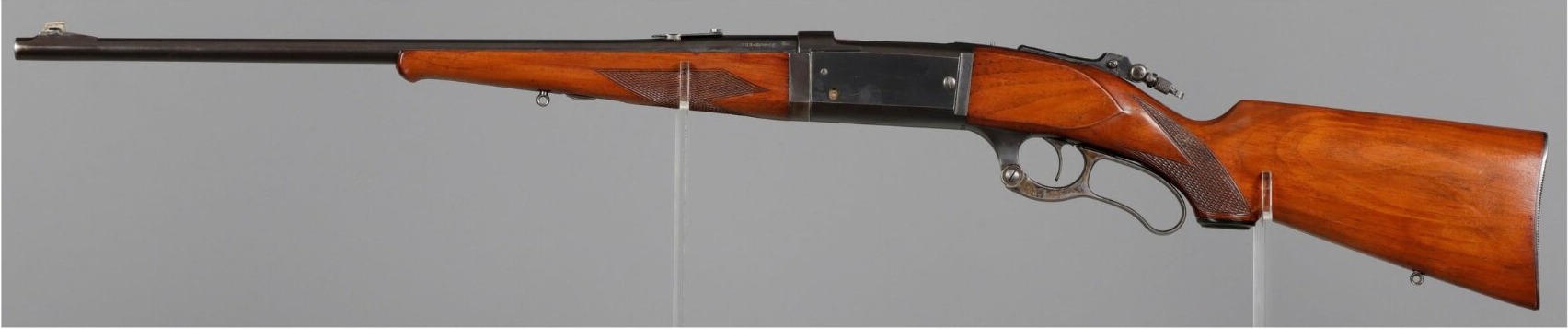
The Model 1895 was further developed and refined, ultimately to become the Savage Model 1899. This rifle incorporated features that significantly improved on the common lever action rifle designs of the period. It was striker fired rather than hammer fired, and was fitted with a rotary magazine. That rotary magazine had an unusual shot counter built in that displayed the number of cartridges left in the magazine via a small window opening on the left side of the action with a brass number: a simple but ingenious feature.
Later model variants of the rifle were fitted with detachable box magazines.
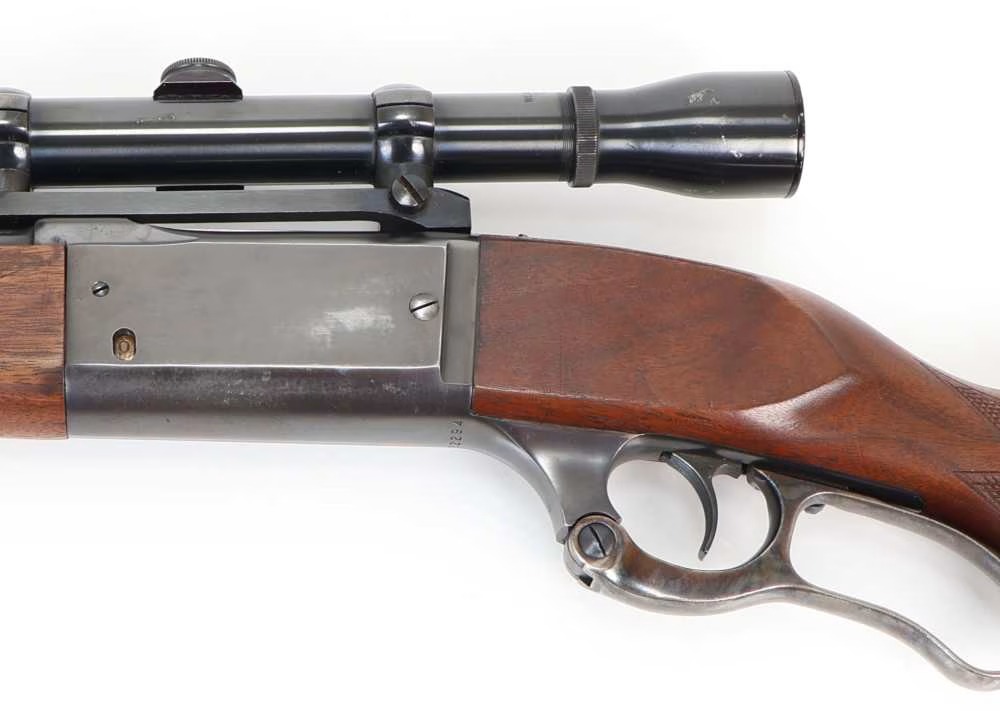
The safety catch on the early models was a tab set behind the trigger which pushed forward for safe where it also locked the lever in the closed position, and was pulled back to ready the rifle for firing. This was replaced by a tang mounted safety catch on later models.
The rifle was designed to handle high pressure nitro powder cartridges so the lock-up needed to be sturdy, and extraction/ejection reliable. The breech-block was designed to lock against the rear of the ejection port. To unlock it the rear of the breech-block was lowered to bring it out of battery and then moved rearwards to extract and eject the fired case.
When the lever was closed its extension moved the breech block forward and then cammed the rear of the breech-block upwards and into battery. The action was cock on closing so the downward stroke of the lever was free and smooth with all the leverage devoted to the unlock-extract-eject cycle.
The action closure was also smooth with the cocking occurring at a point where the shooter’s muscle action was at its strongest.
The action featured a cocking indicator: a useful feature on a hammerless rifle. On the original Model 1895 this took the form of a hole on the top of the bolt through which a “C” for “cocked” or “S” for “safe” cold be seen. On the Model 1899 this was changed to a tab on the top of the bolt that would raise when the rifle was cocked. Then in 1908 this was changed to a pin that would protrude on the top of the receiver to indicate the rifle was cocked.
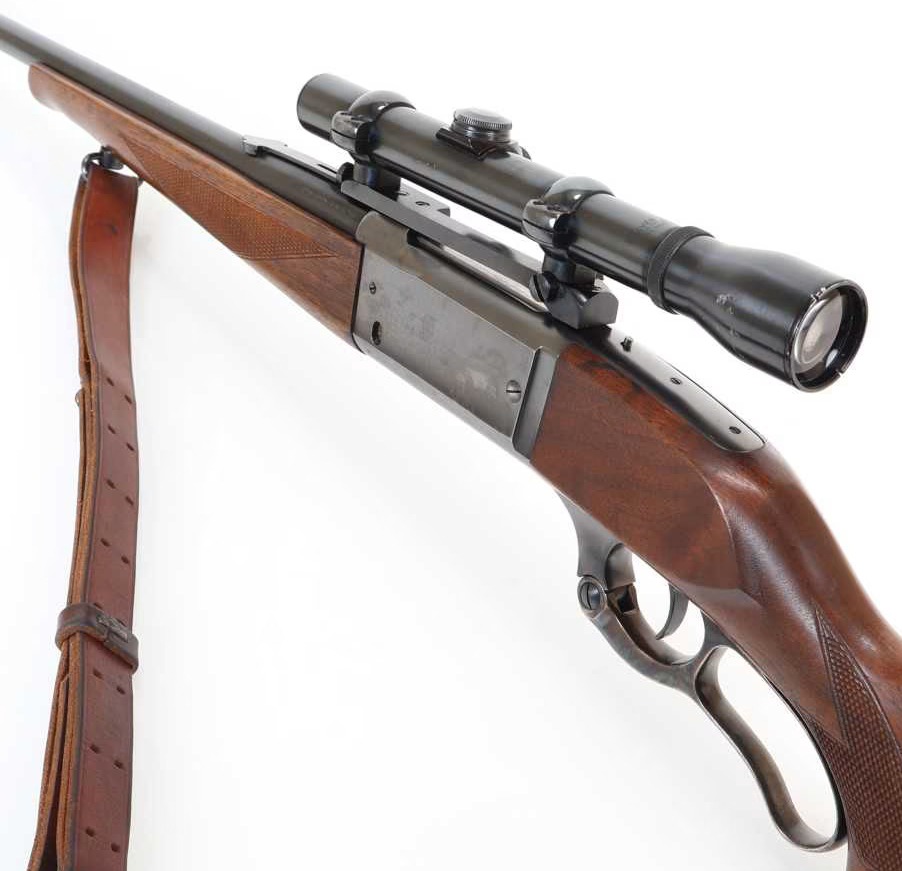
When it was first introduced the Model 1899 was only chambered for the 303 Savage cartridge, this was very similar to Winchester’s 30-30 but was offered with slightly heavier bullets.
In 1900 the Model 1899 was offered in 30-30 Winchester, and then in 1903 they added the 25-35, 32-40 and 38-55.
In 1912 Savage worked in cooperation with rifle and cartridge designer Charles Newton and offered the Model 1899 chambered for his 22 Savage High-Power (metric 5.6x52R). This cartridge used .228″ bullets and sent a 70 grain bullet downrange at a crisp 2,800 fps (850 m/sec) producing energy of 1,493 ft/lb (2,024 Joules).
This was a period of much experimentation and high velocity was seen as delivering power out of proportion to bore diameter and bullet weight. A number of hunters demonstrated this killing power: Christian Missionary to China H.R. Caldwell used his 22 High-Power Model 1899 to kill a 400 lb tiger – tigers being quite common in China around that time.
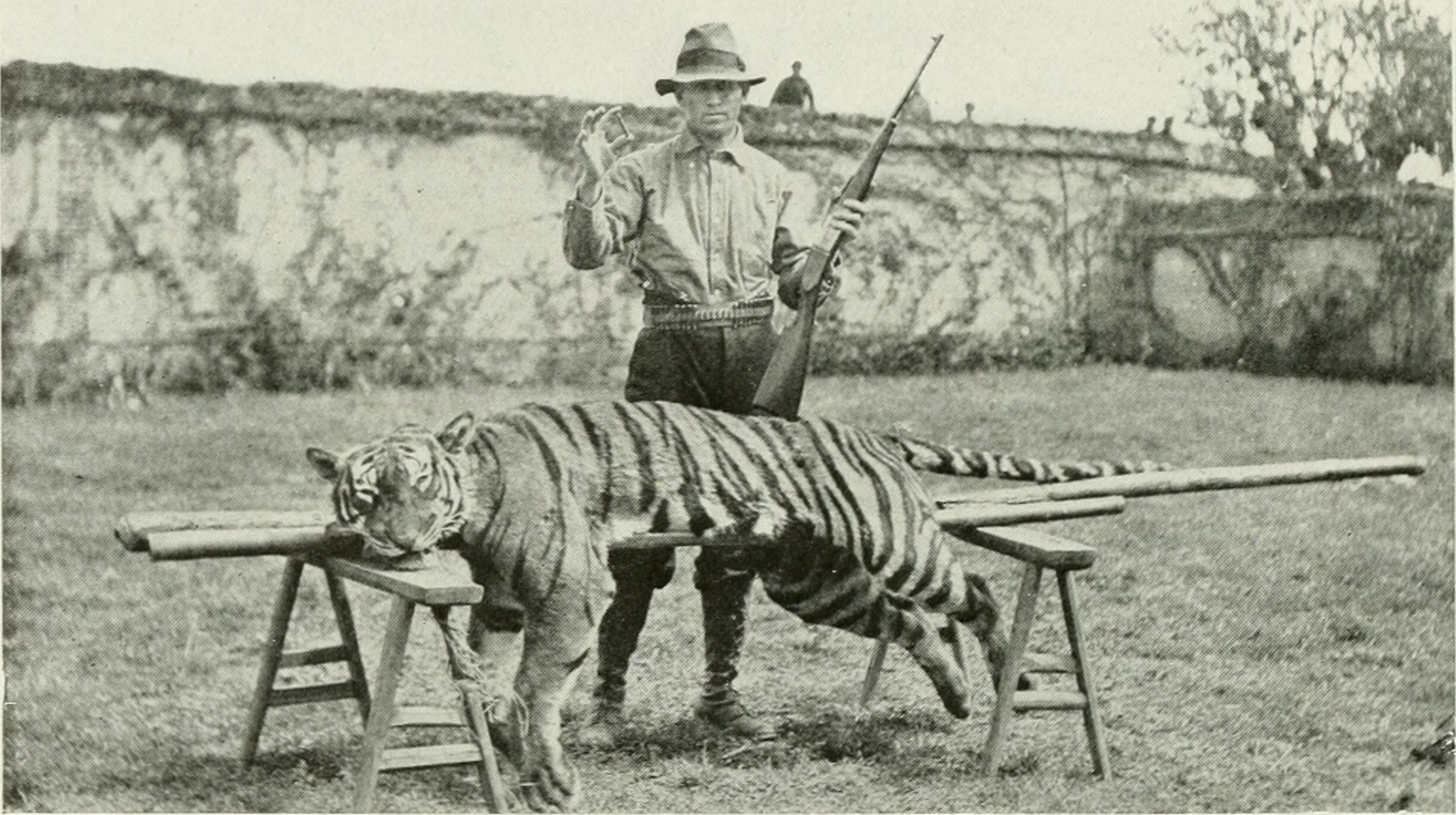
Another prominent user of the 22 High-Power was professional elephant hunter W.D.M. Bell who was a proponent of the use of small bore rifles. Bell did not venture to use the 22 High-Power on elephants, but did use the cartridge on forest buffalo during the 1920’s.
In 1915 Savage chambered the Model 1899 in the Newton designed 250-3000 that delivered an 87 grain bullet at the very fast for that time velocity of 3,000 fps.
1921 saw the introduction of the 300 Savage (the predecessor to the 308 Winchester) and the renaming of the rifle to the Model 99.
In 1956 the Model 99 was chambered for the popular 243 Winchester, 308 Winchester, and 358 Winchester, followed by the 284 Winchester, 375 Winchester, 22-250 and 7mm-08: chamberings that would see the rifle through to its end of production, by which time it had been morphed into no less than 58 model variations.
This Savage rifle acquired for itself a reputation as being easy to carry and capable of sufficient accuracy for the general hunting applications shooters wanted. In short these are a rifle that owners typically keep and use, and pass on down the family.
There were around a million made I believe so they come up on auction sites and at local gun stores.
Rock Island Auction have a few on offer at time of publication.
- Savage Model 99 Lever Action Takedown Rifle with Factory Letter
- Savage Model 1899 Lever Action Rifle
- World War I Era Savage Model 1899 Lever Action Rifle
- Savage Model 1899 Lever Action Rifle
- Savage Model 99 Lever Action Rifle
- Savage Model 99 Lever Action Rifle
Picture Credits: All pictures as individually credited. Feature image at the head of this post courtesy Rock Island Auction.
Jon Branch is the founder and senior editor of Revivaler and has written a significant number of articles for various publications including official Buying Guides for eBay, classic car articles for Hagerty, magazine articles for both the Australian Shooters Journal and the Australian Shooter, and he’s a long time contributor to Silodrome.
Jon has done radio, television, magazine and newspaper interviews on various issues, and has traveled extensively, having lived in Britain, Australia, China and Hong Kong. His travels have taken him to Indonesia, Israel, Italy, Japan and a number of other countries. He has studied the Japanese sword arts and has a long history of involvement in the shooting sports, which has included authoring submissions to government on various firearms related issues and assisting in the design and establishment of shooting ranges.