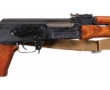

While most people associate the name “Assault Rifle” with the Soviet Russian AK47 “Kalashnikov” the actual concept for this genre of rifle originates in Germany during the Second World War.
Fast Facts
- The StG 44 was the first military small arm to be named as an “Assault Rifle”, and as such it pioneered the genre.
- These types of rifles were originally developed under the name of “Machine Pistol” even though they did not use pistol cartridges. This was done in order to keep the development work secret.
- Once the rifles and their unique ammunition had been developed and deployed they were given the name “Sturmgewehr”, which translates from the German as “Storm Rifle” – i.e. for storming an enemy position – later in English translated as “Assault Rifle”.
It is said by some that “It is better to ask for forgiveness than to ask for permission”. Whether this holds true or not I think depends on the kind of boss you are working for: and in World War 2 Germany some of the military leaders working for Adolf Hitler decided that they would use this strategy in order to create a new type of battlefield rifle that would hopefully be a war winner.
This rifle had to be created somewhat secretly – Hitler was to be kept in the dark about its development and trial deployments – until it had a chance to prove itself – at which point its existence and successes could be communicated to the Fuhrer.
It was a strategy that seems to have worked, and it is said that Hitler himself coined the name for this new rifle, a name that would not only stick to the German rifles, but to the whole family of successors. The name for this new German rifle was “Sturmgewehr”, which translates from the German as “Storm Rifle”, or “Attack Rifle”, or as we know it in English today, the “Assault Rifle’.
This was the new battle rifle concept that would prove to be the pioneer of the modern military rifles that followed from it long after Hitler’s Third Reich had been defeated and faded into history.
It should come as no surprise that Hitler was opposed to the notion of this new attack rifle. He was a veteran of the First World War and his battle experience had been in the trenches armed with a long bolt-action Mauser M1898 type rifle chambered for the full power 7.92×57 German military cartridge. And that long heavy rifle was equipped with a large bayonet making it rather like a heavy spear that could shoot bullets which could travel a couple of kilometers and cause one’s opposition rather a lot of unpleasantness.
Added to that was the fact that the planning for the conquest of Europe had already resulted in the production of large numbers of bolt-action rifles for the foot soldiers along with machine guns and sub-machine guns, and the ammunition to go with them.
But battlefield tactics changed dramatically both during the First World War and in the inter-war years after it. The bayonet charge was not a sensible way to attack an enemy armed with machine guns, and a bolt-action rifle was not the ideal tool with which to tackle a human wave charge by a numerically superior foe. The old ideas had become obsolete, and new tactics required new tools with which to employ them.

Germany’s arms designers and manufacturers were already alert to the need for a new type of infantry weapon by the mid-1930’s – one which combined the advantages of the sub-machine gun with the practical range (i.e. 300 meters or so) of a rifle. and so they had begun work on both design of a new cartridge concept, and a new rifle to go with it.
This work on a new rifle actually began with development of a suitable cartridge and this work began remarkably early: the concept was being thought about as early as 1918 with German ammunition maker RWS (Rheinisch-Westfälische Sprengstoff) beginning work in the 1920’s.
Germany’s other ammunition makers also began development work: these being DWM (Deutsche Waffen und Munitionsfabriken), and Geco (Gustav Genschow & Co).
In 1938, seeing what was being developed, the German government’s Heereswaffenamt (HWA – the German military weapons agency) commissioned industrial company Polte (Polte Armaturen- und Maschinenfabrik OHG) to design a cartridge that would be similar to the prototypes developed by the other companies and that would fulfill the military’s requirements for a rifle cartridge that would be effective out to 400 meters, and suitable for a semi-automatic infantry rifle. The result was the 7.92×33mm Kurz, a significantly shortened cartridge based on the same cartridge case head size as the 7.92×57 full size military rifle, and using a bullet of the same diameter.
At around the same time the HWA commissioned arms maker C. G. Haenel to design a suitable rifle. This rifle was to be no longer or heavier than the then standard issue Kar 98k. It was to provide semi-automatic and full automatic fire with a cyclic rate of not more than 450 rounds per minute (rpm), and the rifle was to be able to be conveniently mass produced. 50 prototypes were to be submitted for evaluation in 1942.

Haenel had famous weapons designer Hugo Schmeisser design their new rifle, the Maschinenkarabiner 42(H), abbreviated to MKb 42(H), meaning “Machine carbine model of 1942 (Haenel)”.
While Haenel were working on their design competing arms maker Walther were also asked to develop a carbine of their own design. The Haenel prototype rifle was striker fired and fired from an open bolt whereas the Walther was hammer fired from a closed bolt.
After trials and re-design work the best features of the two designs were blended into a new rifle that incorporated the most successful features of each of the competing designs.
The resulting rifle was the Maschinenpistole 43 (MP43), which fired from a closed bolt and incorporated a hammer firing mechanism with gas operated tilting bolt.
It is interesting to note that this new rifle was being referred to as a “machine pistol” at that time. Hitler had forbidden the development of a new rifle, but sub-machine guns were allowed. So this name helped keep the new rifle “under the radar” while it was in development.
A modest number of the new rifles were deployed to selected units on the Eastern Front where they proved to be highly successful. These were designated the MKb 42(H) and the numbers made and deployed were in the thousands, 7,957 in total.

When Hitler was apprised of this new rifle and its successes it is said that he was delighted, and coined the name “Sturmgewehr” for it. So it was that the StG 44 was born: and it was on the Eastern Front that it proved to be an excellent infantry weapon.
At the very core of Hitler’s priorities in waging his war of conquest was Operation Barbarossa – the invasion and takeover of Soviet Russia. By this he planned to eliminate the communists and provide for the German people “Lebensraum” – living space.
However, as the German army advanced into Soviet Russia it quickly became clear that the Russians were not at all willing to give up their country – and were willing to give their lives to defend it.
Russia faced great difficulties in fielding and arming their fighting men and in the early stages of the fighting many soldiers went into battle without a rifle, with instructions to charge the enemy with your armed comrades and when one falls pick up his rifle and continue the attack.
Full size rifles were slow to make and, realizing this, Russia’s military and industrial leadership reasoned that sub-machine guns and their ammunition were much easier to make, and easy for soldiers at a low level of training to deploy. So the PPSh-41 was used to arm large numbers of Soviet Russian troops.

This strategy had proved effective in the 1939-1940 Winter War when the Soviets had tried, unsuccessfully, to invade Finland. But both sides had deployed sub-machine guns for the close range forest fighting that had characterized parts of that war and found them to be a good choice despite the fact that they used low powered pistol ammunition.
But pistol ammunition is small and light: so a soldier can carry lots of it. Magazine capacity of sub-machine guns is large: for the PPSh-41 the magazine was either a 35 round stick or a 71 round drum. And of course recoil and muzzle blast were quite light and easier for a soldier to manage.
It was against the Red Army and their tactics that the StG 44 earned its keep as a new concept in battle rifles. The Soviet military were so impressed with it that their own weapons designer, Mikhail Kalashnikov, set to work to create his own design, based on the “Assault Rifle” concept pioneered by the Germans, with the result being the AK47 and its 7.62×39 cartridge.
Following on from that in the post-war “Cold War” period were a plethora of “assault rifle” designs including the AR15 style rifles that have become so popular in the United States.
Picture Credits: Feature image at the head of this post courtesy Rock Island Auction. All others as individually credited.


Jon Branch is the founder and senior editor of Revivaler and has written a significant number of articles for various publications including official Buying Guides for eBay, classic car articles for Hagerty, magazine articles for both the Australian Shooters Journal and the Australian Shooter, and he’s a long time contributor to Silodrome.
Jon has done radio, television, magazine and newspaper interviews on various issues, and has traveled extensively, having lived in Britain, Australia, China and Hong Kong. His travels have taken him to Indonesia, Israel, Italy, Japan and a number of other countries. He has studied the Japanese sword arts and has a long history of involvement in the shooting sports, which has included authoring submissions to government on various firearms related issues and assisting in the design and establishment of shooting ranges.