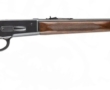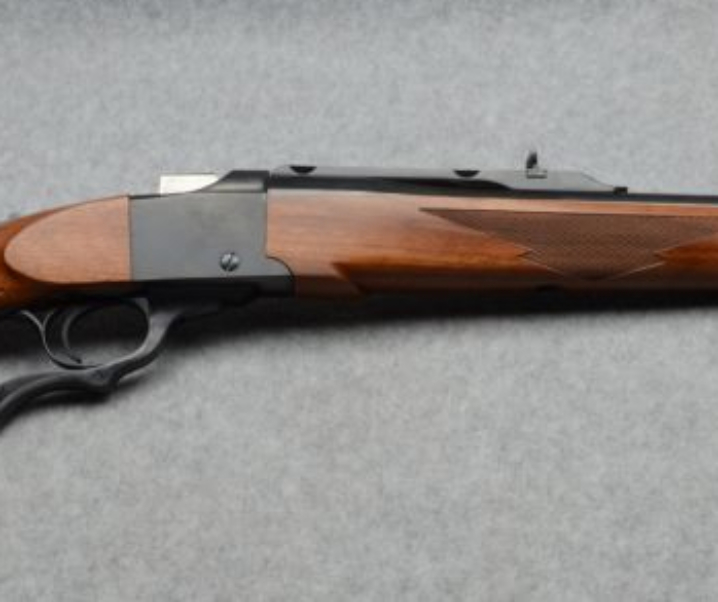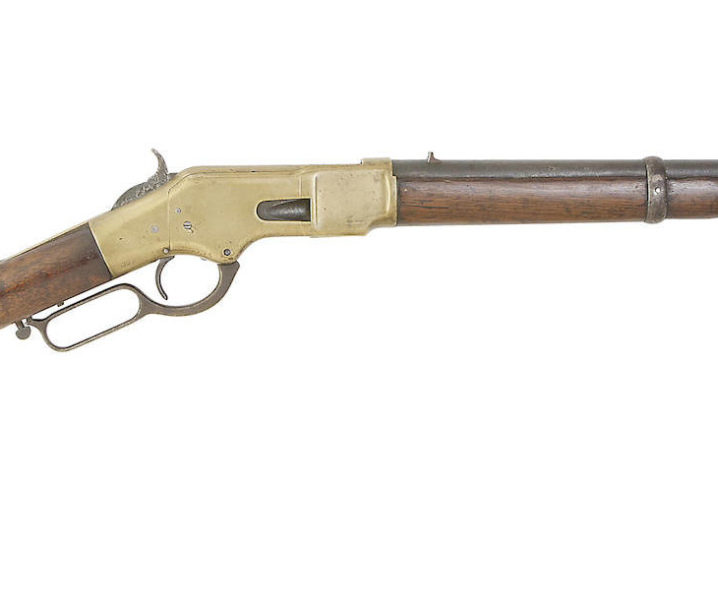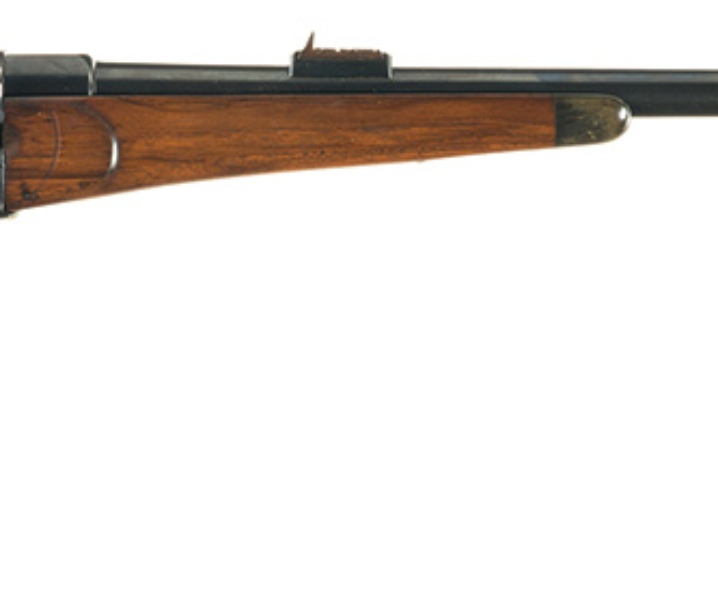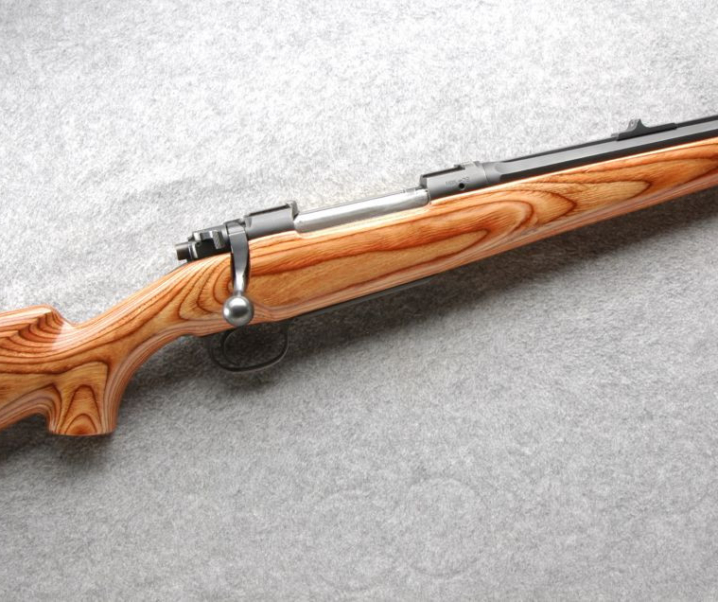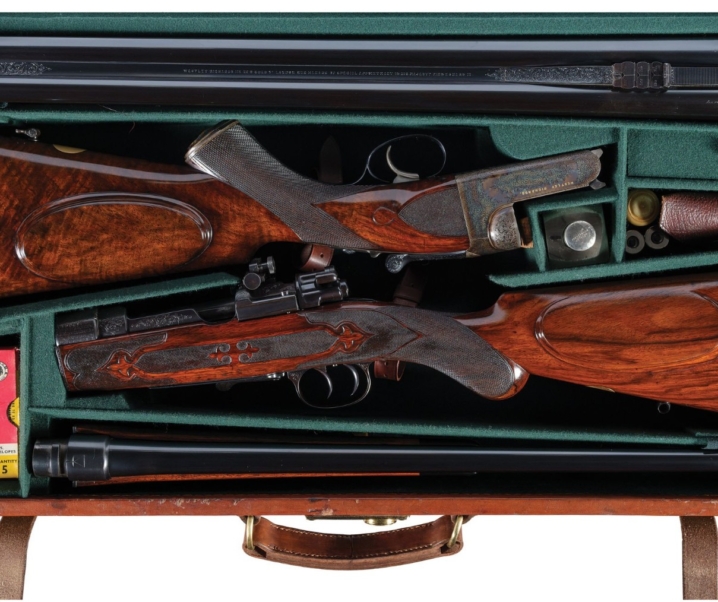
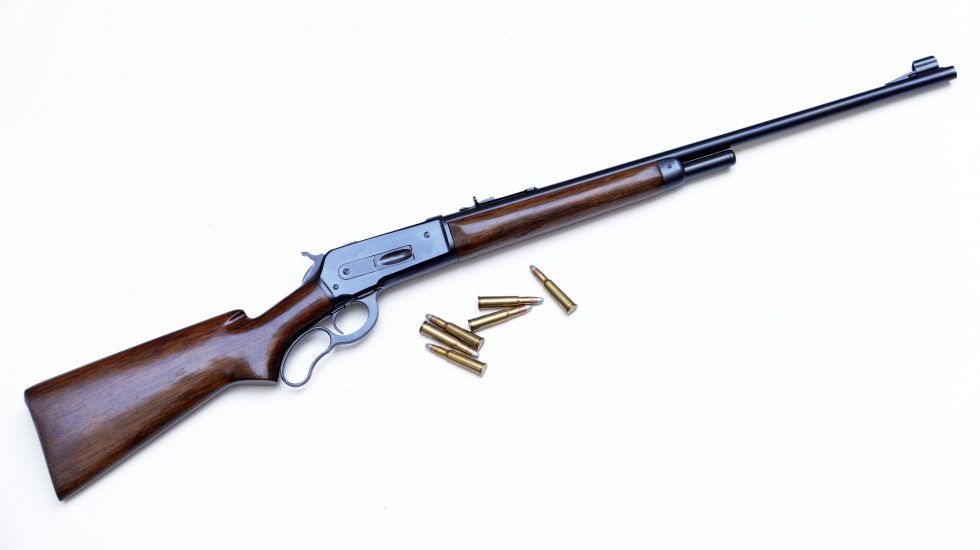
The 348 Winchester cartridge was designed to be a replacement for the 33 WCF and the 405 Winchester and was only chambered in the Winchester Model 71 rifle. The 348 Winchester made the Model 71 a very capable medium bore for thin skinned game – including potentially dangerous game.
Fast Facts
- The 348 Winchester cartridge was designed specifically for the John Moses Browning designed Winchester Model 71 rifle.
- The 348 Winchester was created to replace a number of cartridges such as the 33 WCF and the 405 Winchester.
- In power, the 348 Winchester was created as a potent medium bore and its performance was very similar to the 318 Westley Richards which had forged for itself an excellent reputation.
- The Winchester Model 71 rifle offered similar performance to the 318 Westley Richards but in a conventional lever action rifle with side-gate loading and a tube magazine.
The 348 Winchester was created as a modern replacement for a raft of Winchester cartridges including the 33 WCF and Teddy Roosevelt’s favorite, the 405 Winchester, which he described as his “medicine gun for lions” in his book “African Game Trails“.
So the 348 Winchester was created to, in part, fulfill that same role as a medium bore with which to tackle not only North American, but also African and Asian big game.
The 405 Winchester had been chambered in the box magazine Winchester Model 1895 that had been offered both as a sporting and a military rifle chambered for a variety of cartridges.
The 405 Winchester offered two main loadings:-
- 300 grain (19 gram) bullet @ 2,204 fps (672 m/sec) for a muzzle energy of 3,236 ft/lb (4,387 Joules).
- 400 grain (26 gram) bullet @ 1,900 fps (580 m/sec) for a muzzle energy of 3,207 ft/lb (4,348 Joules).
Winchester designed the 348 Winchester cartridge to provide the same sort of dangerous game capabilities as the 405 Winchester, and also to provide loadings suitable for use on deer and wild pigs/wild boar.
To this end the 348 Winchester was offered with these three loadings:-
- 150 grain (10 grams) bullet @ 2,890 fps (880 m/sec) with energy of 2,780 ft/lb (3,770 Joules).
- 200 grain (13 grams) bullet @ 2,530 fps (770 m/sec) with energy of 2,840 ft/lb (3,850 Joules).
- 250 grain (16 grams) bullet @ 2,630 fps (800 m/sec) with energy of 3,072 ft/lb. (4,150 Joules).
Winchester’s engineers were, without doubt, familiar with the wildcat 35 Whelen, and I think that Winchester’s design engineers did some research as to the cartridges that had established a reputation for reliability on thin skinned African and Asian game with a view to making their new 348 Winchester provide the sort of performance needed, but that this performance was to be provided in an American style lever action rifle: and to this end the Winchester Model 1886 was modernized to become the new Winchester Model 71 – which was only to be chambered for the 348 Winchester cartridge.
It is likely that Winchester’s engineers were familiar with the British and European cartridges that had established a good reputation in Africa and Asia and that their research had made them aware of the British 318 Westley Richards and the German 9.3x74R and 9.3×62, all of which were offered in quite lightweight rifles.
The 318 Westley Richards and the 348 Winchester are ballistically rather similar. Below are the standard loadings for the 318 Westley Richards:-
- 180 grain (12 gram) bullet @ 2,700 fps (820 m/sec) with energy of 2,920 ft/lb (3,960 Joules).
- 250 grain (16 gram) bullet @ 2,400 fps (730 m/sec) with energy of 3,194 ft/lb (4,330 Joules).
The 348 Winchester offered about the same power as the 318 Westley Richards, and a tad less than the 9.3x74R and the 9.3×62. It was indeed a “big medicine gun“.
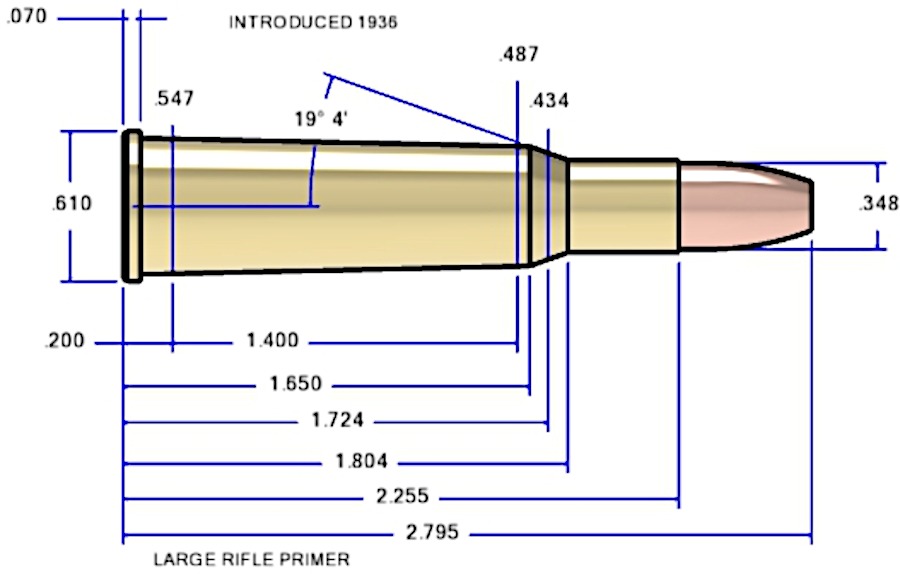
There is of course a lot more to creating a rifle and cartridge than just the ballistics. As such cartridges as the 9.3x74R and the 375 Holland & Holland Flanged Magnum illustrate, the cartridge needs to have a fairly wide base and pronounced case body taper so that the breech offers a nice big opening for the cartridge to be chambered, and to assist with easy ejection.
Winchester’s engineers based the 348 Winchester on the black powder 50-110, which has a slightly larger base diameter than the 45-70. They gave the case body a good amount of taper, with the intention of making feeding, chambering and extraction efficient and drama free whether the rifle was to be used in a hot or sub-arctic environment – whether in the heat of Africa or up north in Alaska – this was to be a rifle that would function flawlessly.
Not only was the new Model 71 in 348 Winchester to be smooth operating and boringly reliable, but it also offered the advantage of a side-gate loading tube magazine – a magazine that was easy to top up load. This is especially useful in situations where there are going to be multiple shots fired such as when dealing with a game animal that takes a lot of persuading to lay down and die, or in a situation where you have multiple animals to account for and the action is fast and unpredictable – as can happen with wild pig shooting or driven wild boar.
Reloading the 348 Winchester
As one might expect for a cartridge that was based on a relatively uncommon black powder parent case and which uses bullets of a diameter not found on anything else, finding components with which to brew up ammunition for the 348 Winchester is a bit of a challenge: not in the “Quest of the Holy Grail” league, but it is a quest that can be expected to require some effort in research.
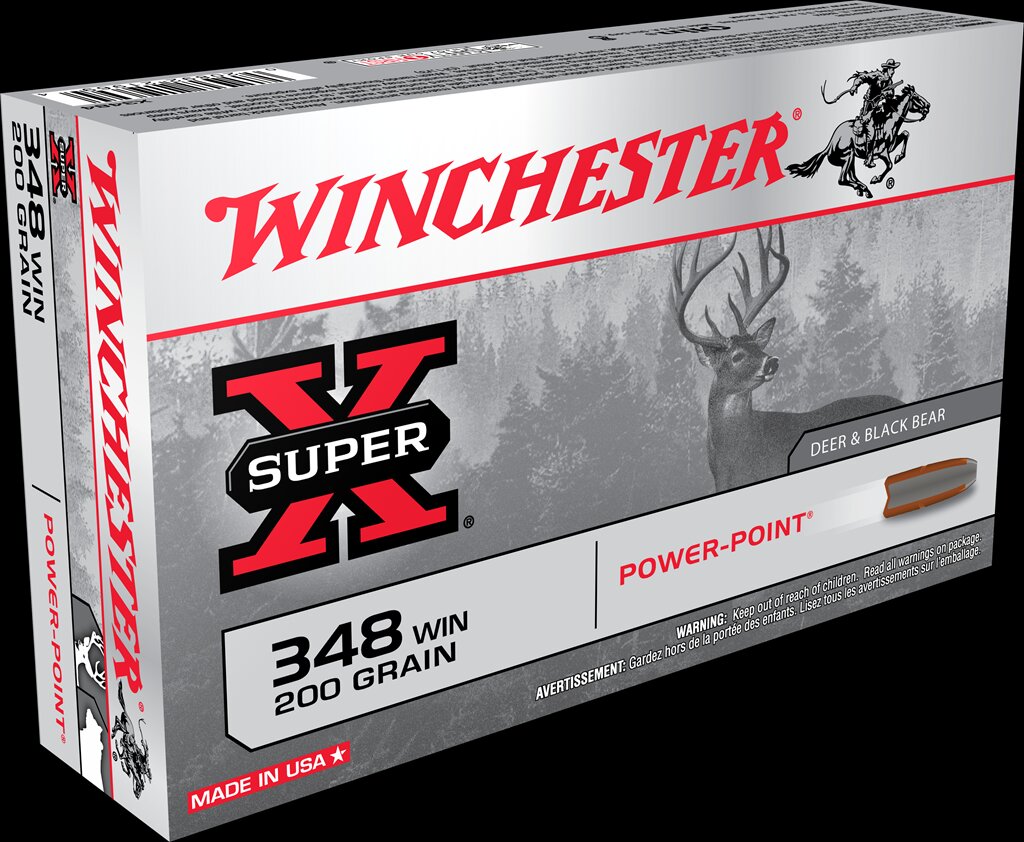
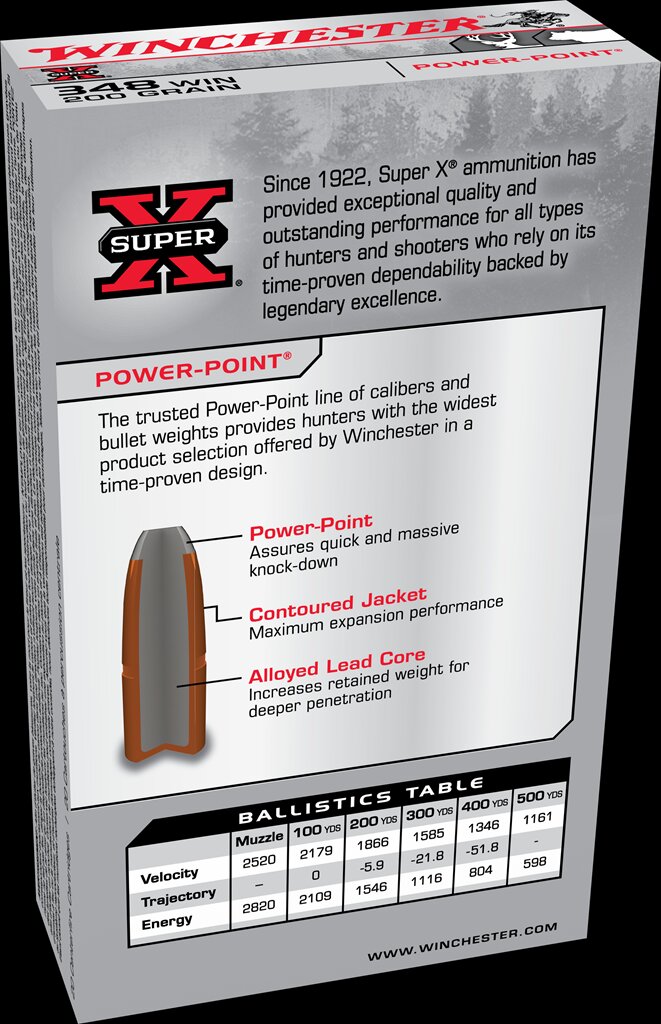
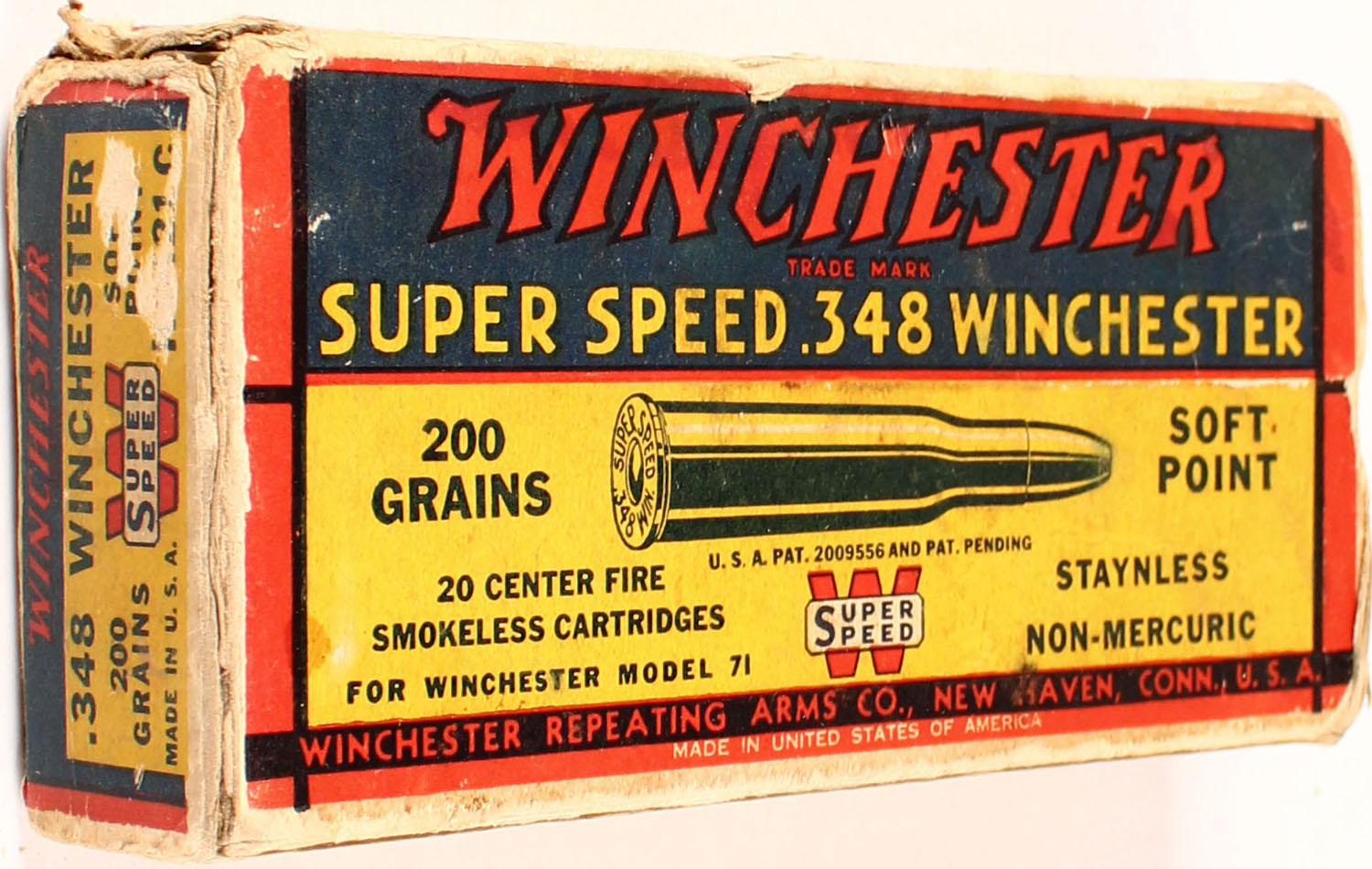
Cases are the first challenge. Winchester lists the 348 Winchester on their website as loaded ammunition which you will find if you click here.
- That load is for a 200 grain Power Point (flat nose) bullet @ 2,520fps (768 m/sec) for muzzle energy of 2,820 ft/lb (3,823 Joules).
Hornady used to offer ammunition in 348 Winchester but it is currently listed as “discontinued” as are the bullets. Hornady offered a 200 grain Flat Point Interlock and a 200 grain FTX plastic tipped bullet.
You will find the listing on the Hornady website with their load data if you click here.
Starline Brass lists empty cases which you will find if you click here.
You will also find a good set of listings on Gunbroker.com if you click here.
Once you have cartridge cases the next step in your quest is to find suitable bullets. The 348 Winchester uses bullets of .348″ diameter, and this is a unique size.
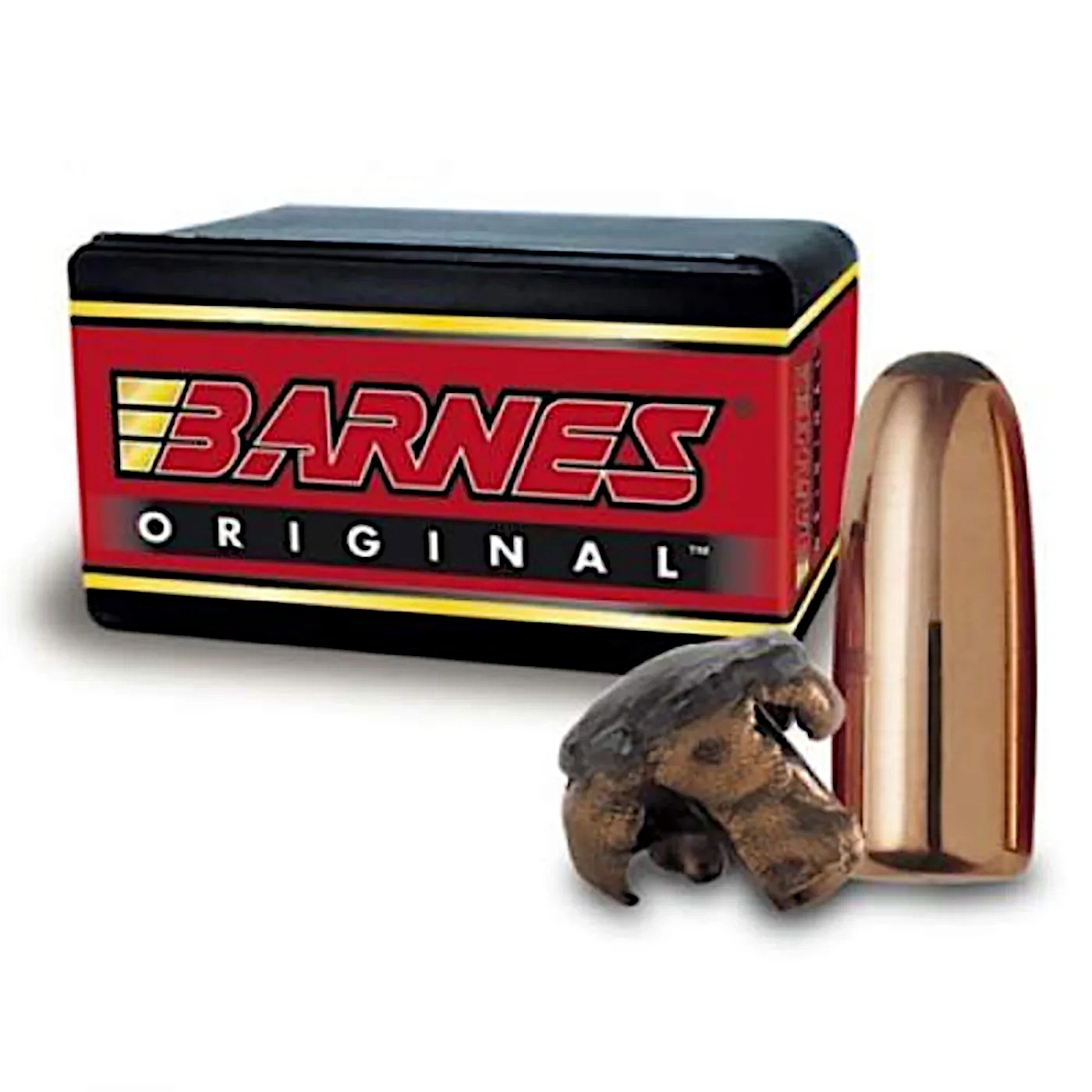
Not many manufacturers have offered bullets suitable for the 348 Winchester. Winchester themselves have and so have Barnes and Hornady.
- The Barnes Bullets can be found if you click here.
- Load Data for the Barnes Bullets can be found if you click here.
There is a bit more load data in the printed Barnes Reloading Manual – I checked in mine which is Reloading Manual Number 4.
Cutting Edge Bullets make 200 grain and 175 grain .348″ bullets which you’ll find if you click here.
Hodgdon provide the load data for available powders and bullets. You will find this if you click here and then choose “Rifle” and select the 348 Winchester.
The bullets listed are the Hornady 200 grain Flat Point Interlock, 200 grain FTX, and the Barnes 220 grain FN-O, and 250 grain Flat Nose.
There is also listed the Lyman cast 250 grain Flat Nose Gas Check.
You will find the Hodgdon load data if you click here.
Reloaders in Australia and New Zealand are best advised to consult the ADI website which features the powders by their Australian market names.
You will find the 348 Winchester load data for ADI powders if you click here.
Checking my modest library of printed reloading manuals I find the 348 Winchester listed in the Lyman Reloading Handbook 49th Edition and in the Lyman Cast Bullet Handbook – Third Edition.
Australian Bullet maker Woodleigh Bullets list the 348 Winchester in their Loading Manual. The listing is for the Woodleigh 250 grain FN SN bullet.
Woodleigh Bullets have established a strong reputation for excellence both in manufacturing and performance.
Conclusion
While ammunition and reloading components for the 348 Winchester are normally not easily available the brilliant Winchester Model 71 makes the effort required to get it shooting well worth it.
The Model 71 rifle is an outstanding example of the design genius of John Moses Browning, and the 348 Winchester cartridge that was specifically designed for it turns the rifle into a superb medium bore capable of efficient work on all North American game and thin skinned game in Africa.
Those who use a 348 Winchester as their “go to” rifle are often people with extensive field experience who understand and value the features that make this rifle and cartridge combination so desirable.
Picture Credits: Feature image at the head of this post courtesy Winchester. All other pictures individually credited.

Jon Branch is the founder and senior editor of Revivaler and has written a significant number of articles for various publications including official Buying Guides for eBay, classic car articles for Hagerty, magazine articles for both the Australian Shooters Journal and the Australian Shooter, and he’s a long time contributor to Silodrome.
Jon has done radio, television, magazine and newspaper interviews on various issues, and has traveled extensively, having lived in Britain, Australia, China and Hong Kong. His travels have taken him to Indonesia, Israel, Italy, Japan and a number of other countries. He has studied the Japanese sword arts and has a long history of involvement in the shooting sports, which has included authoring submissions to government on various firearms related issues and assisting in the design and establishment of shooting ranges.