Among the most respected luxury car makers of the 1920’s and 1930’s stands Hispano Suiza. These cars blended Swiss engineering with Spanish and French style to create some of the most desirable automobiles of the classic car era.
Fast Facts
- Hispano Suiza is an automobile marque that epitomises the best in design and engineering. It stands in the same level of respect given to such makers as Rolls-Royce, Isotta Fraschini, and Avions Voisin.
- Hispano Suiza were one of the most prominent luxury car makers of the 1920’s and 1930’s.
- Hispano Suiza also designed and made aircraft engines, and the technology of these aircraft engines was incorporated into the automobile engines also.
- The Hispano Suiza H6 was one of the company’s most iconic models. The H6 automobiles were made in France.
- In 1929 production of H6 was transferred to Spain and the model designation became T56.
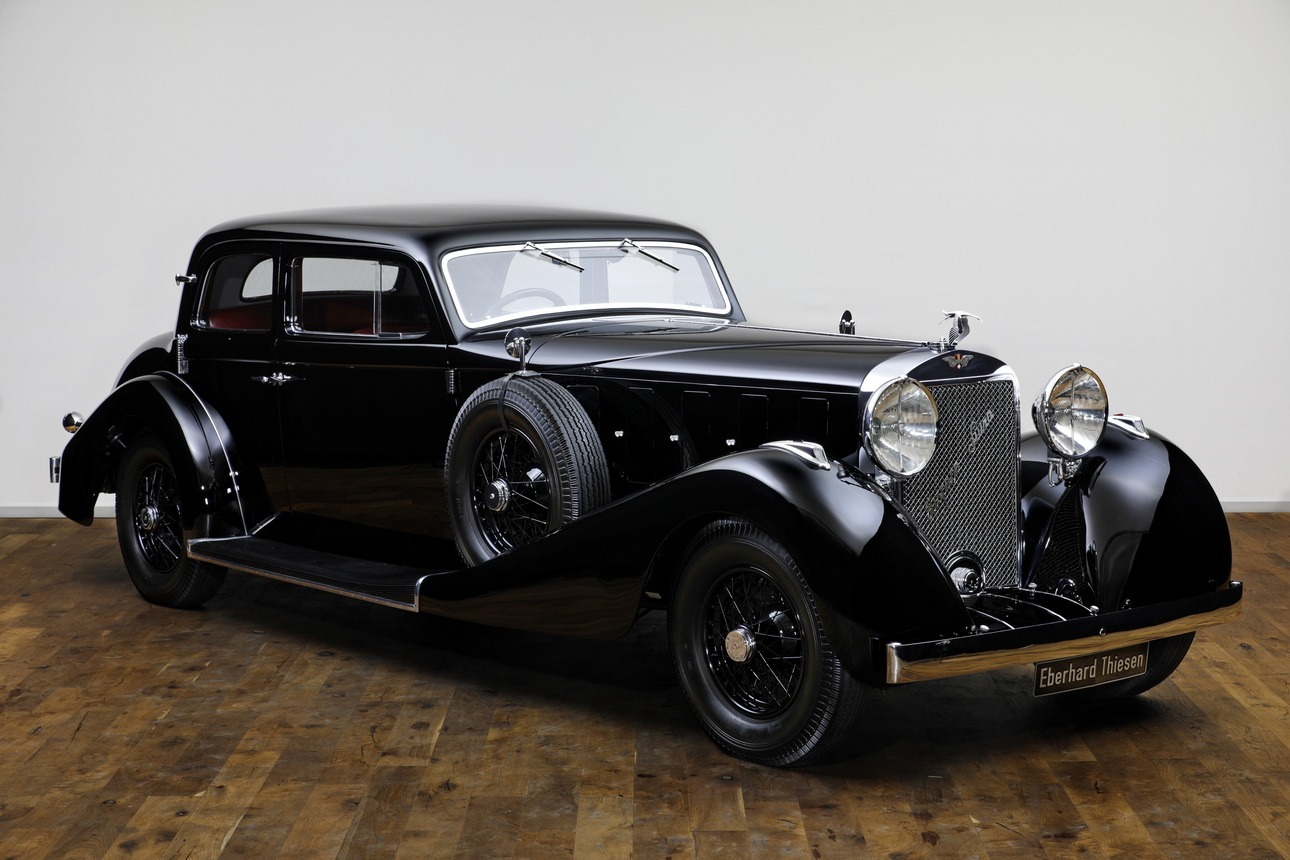
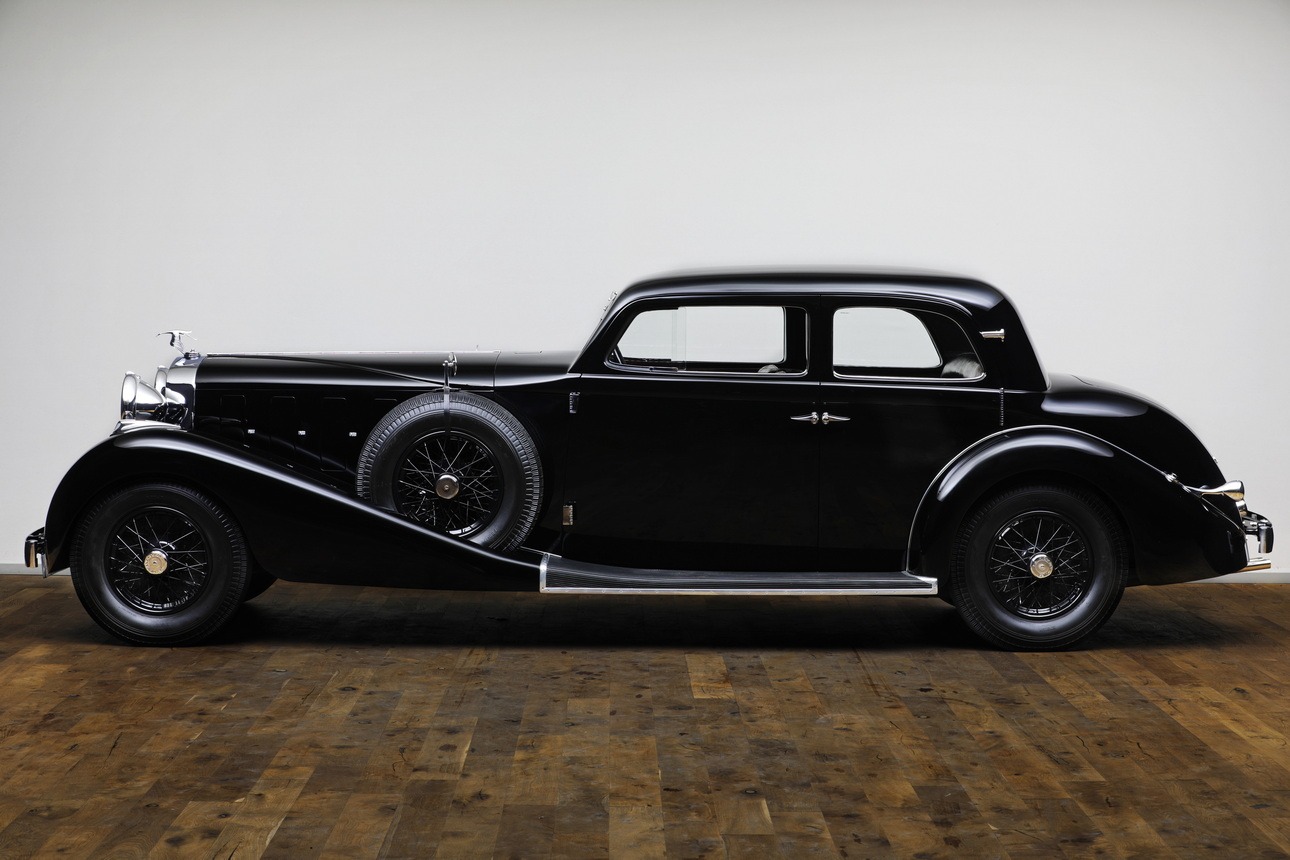
- A 1934 Hispano Suiza T56 with coachwork by Fiol is for sale by Eberhard Thiesen at time of publication.
Background History
The name Hispano Suiza stands out among the creators of the greatest automobiles of the classic era of motor cars: the 1920’s and 1930’s. These cars competed in the same marketplace as the likes of Rolls-Royce, Bentley, Isotta Fraschini, and Avions Voisins among others: they were makers of the most prestigious and most expensive automobiles that anyone could aspire to.
Hispano Suiza were initially based in Spain under the leadership of Swiss engineer Marc Birkigt and Spanish entrepreneur Damián Mateu in 1904.
Birkigt came into this new enterprise from time working in Barcelona for the La Cuadra company where he had designed two automobiles, a 4.5hp single cylinder and a two cylinder 1.1 liter 7.5hp: both of these models dated around 1900.
The La Cuadra company came under the ownership of José María Castro Fernández in 1902 and the new company was named Fábrica Hispano-Suiza de Automóviles. This did not last however and in 1904 after restructuring a new company La Hispano-Suiza Fábrica de Automóviles was formed, at that time still under the direction of Castro.
This new permutation of Hispano Suiza with Birkigt and Mateu set about the creation of a series of new automobile models based around new engines created by Birkigt; two four cylinder engines of 3.8 liters and 7.4 liters capacity, and two six cylinder engines.
Hispano Suiza (which translates from the Spanish as “Spanish-Swiss”) began the wise process of diversifying their industrial products and by 1914 were working on military aircraft engines. Birkigt, with the assistance of engineer Louis Massuger created a pioneering aircraft engine which used a cast aluminium block with steel cylinder liners. This family of engines featured overhead camshafts and formed the technology basis for Hispano Suiza’s automobile engines.
The Hispano Suiza H6 Makes its Debut
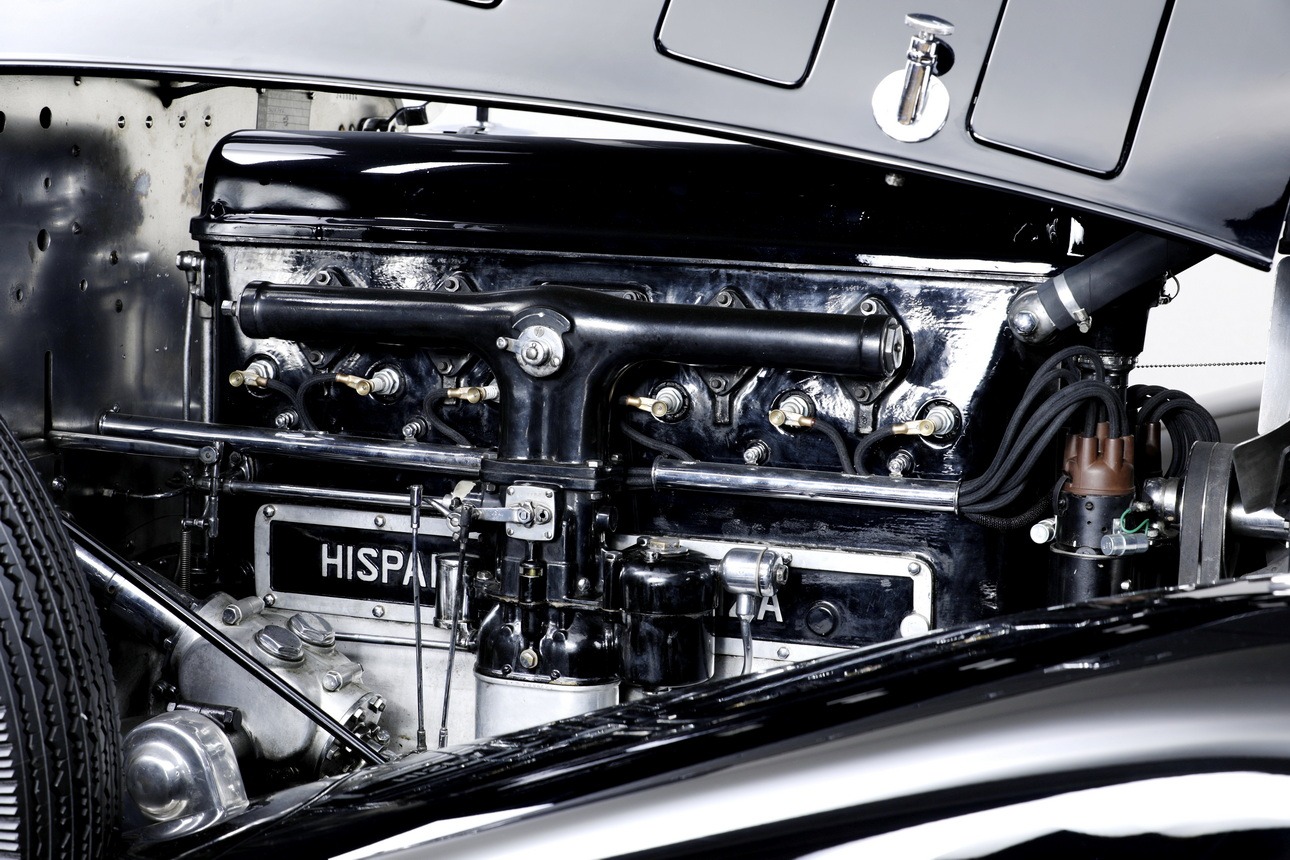
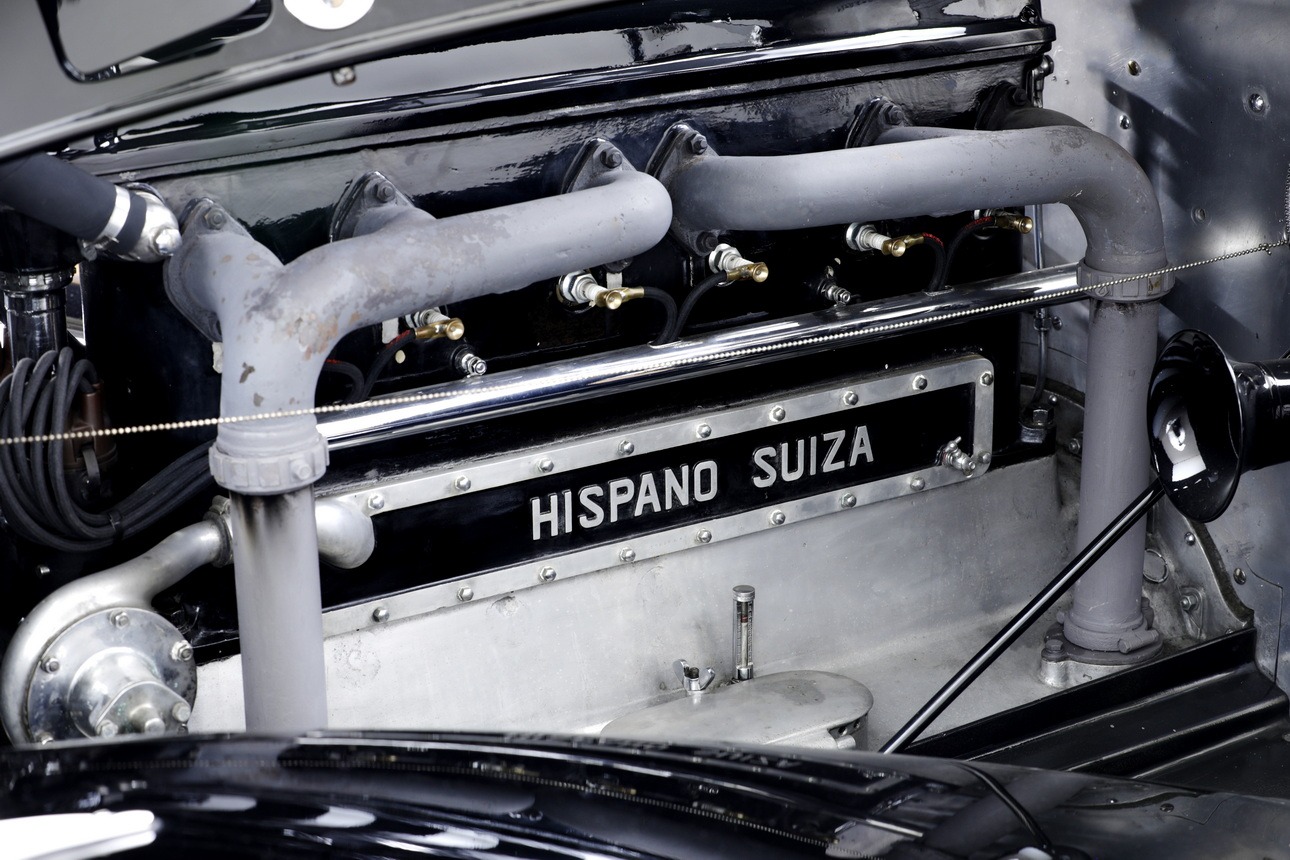
After the end of the First World War in 1919 Hispano Suiza introduced their new H6 model. The engine of the H6 was an inline six cylinder with a single overhead camshaft which was driven by a “kingshaft” (German “Königswelle”).
This unusual technology for driving an overhead camshaft involves a shaft that connects from a gear on the crankshaft to a gear on the overhead camshaft. The gears at each end of the kingshaft are bevel gears and make it look a little like a king’s scepter.
The kingshaft provides a very direct mechanical connection between the crankshaft and camshaft which is rather more solid than a cam chain or belt.
The 6.6 liter H6 was first shown at the Paris Motor Show of 1919. Hispano Suiza had opened a manufacturing facility near Paris at Bois-Colombes that was named Société Française Hispano-Suiza. The majority of Hispano Suiza high end luxury cars were made at this facility.
The all aluminum engine had 7 main bearings, screwed in bore liners, and a capacity of 6,597cc (403 cu. in.) and was equipped with dual spark plug ignition – a legacy of its aviation technology origins. It’s crankshaft was milled from a solid steel billet of 600lb (272kg) weight which ended up as a complete crankshaft that weighed 35 lb (16 kg).
To mitigate against corrosion the water channels in the engine were enameled.
The chassis of the Hispano Suiza H6 was fairly 1920’s-1930’s conventional with a front beam axle and live axle with semi-elliptic leaf springs at the rear: but with subtle and significant improvements that included mechanical power assisted aluminum alloy drum brakes. Aluminum alloy conducts heat more efficiently than iron or steel and so these provided better resilience where the brakes were subjected to long repeated use such as when descending a long slope.
The transmission was a three speed manual with center mounted gear lever.
The H6 underwent progressive improvements: the H6B featured a new clutch while the H6C had its engine capacity increased to 8 liters (488 cu. in.) and delivered approximately 160hp.
The H6 was exclusively built in France up until 1929, when Hispano Suiza’s leadership decided it would be wise to move manufacturing of the model to Spain, where they were made at the La Sagrera facility.
The H6 models made in Spain were designated T56.
A 1934 Hispano Suiza T56 with Coachwork by Fiol for Sale
One of the Spanish made Hispano Suiza T56 automobiles is offered for sale by Eberhard Thiesen in Hamburg, Germany, at time of publication.
This car is fitted with the 8 liter (7,983cc) SOHC six cylinder engine which produces approximately 150 hp @ 3,000 rpm.
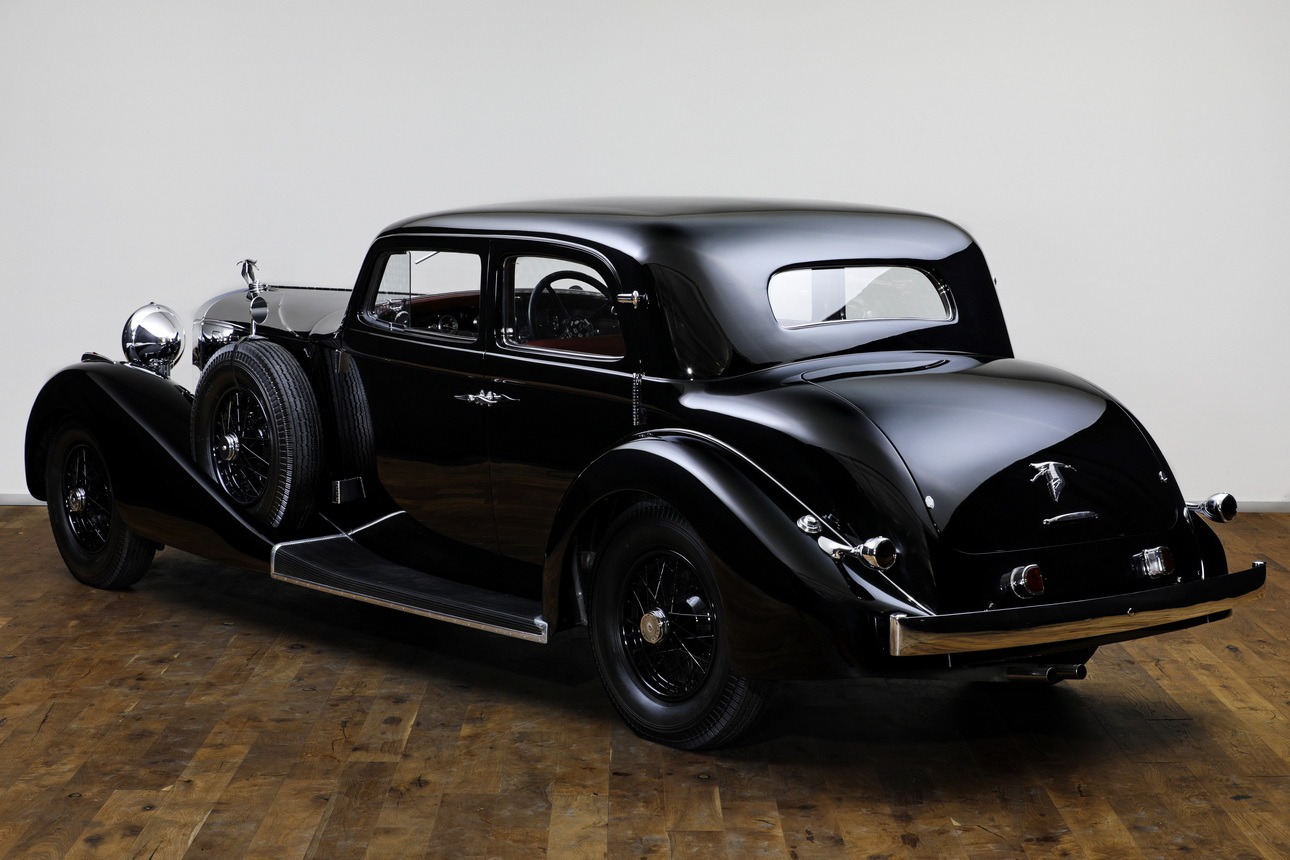
The rolling chassis is fitted with “Berline de Voyage’ (travel saloon)” coachwork by Fiol, and the odometer reads 27,895 km.
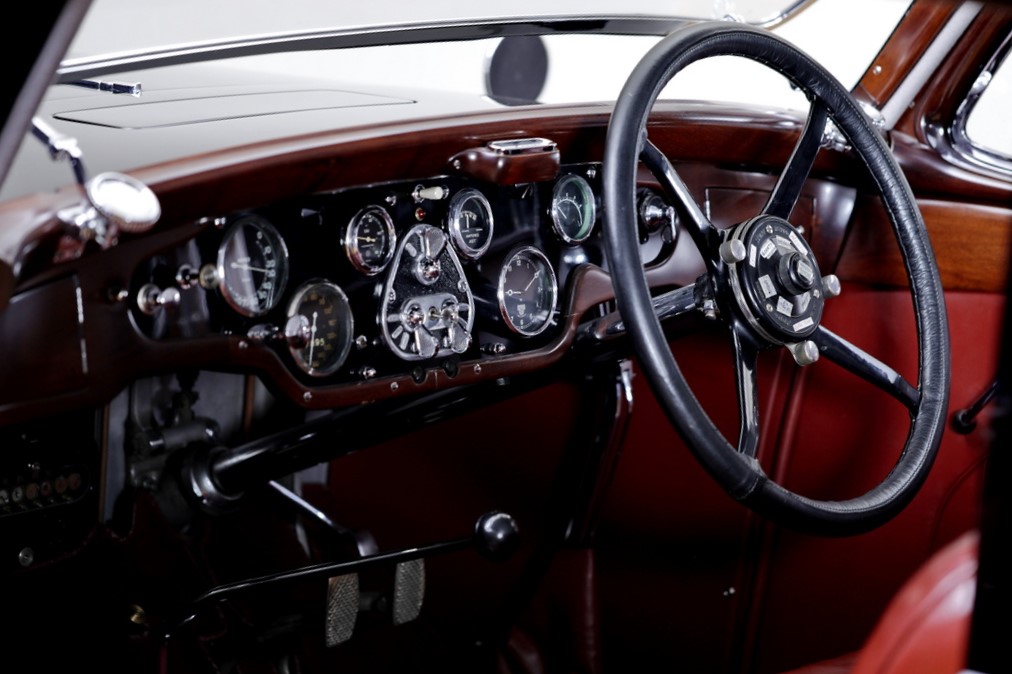
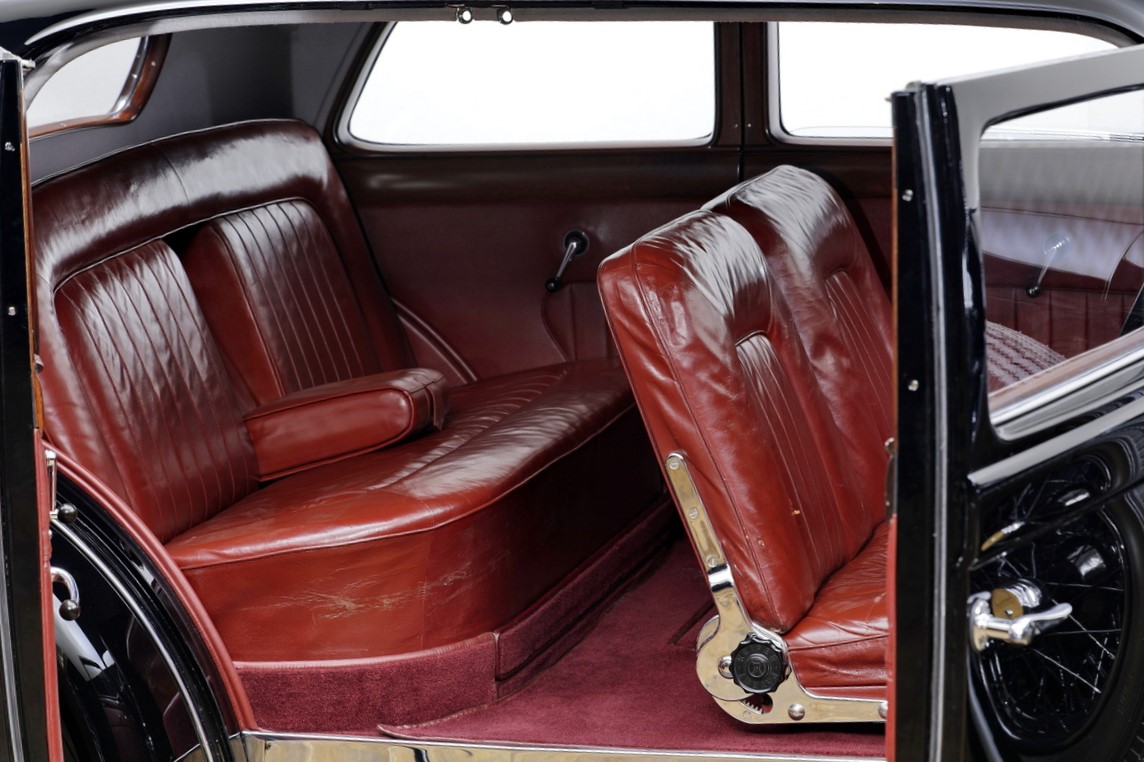
The body style is gorgeously conservative, finished in black with a red leather interior the car has an impressive presence and tips the scales at 2,425 kg.
Among the car’s distinctive features are its doors. The front doors swing forward while the rear doors open backwards. So when one opens the doors together it is rather like opening a wardrobe and it provides wide open access to the interior.
From 2014-2019 the car was treated to an extensive restoration in the Czech Republic. The engine was already in perfect condition and did not require restoration work, and the interior was likewise in good shape.
The gearbox has been reconditioned and the engine serviced.
Picture Credits: All pictures courtesy Eberhard Thiesen.
Jon Branch is the founder and senior editor of Revivaler and has written a significant number of articles for various publications including official Buying Guides for eBay, classic car articles for Hagerty, magazine articles for both the Australian Shooters Journal and the Australian Shooter, and he’s a long time contributor to Silodrome.
Jon has done radio, television, magazine and newspaper interviews on various issues, and has traveled extensively, having lived in Britain, Australia, China and Hong Kong. His travels have taken him to Indonesia, Israel, Italy, Japan and a number of other countries. He has studied the Japanese sword arts and has a long history of involvement in the shooting sports, which has included authoring submissions to government on various firearms related issues and assisting in the design and establishment of shooting ranges.